



A bone scan comes back with a number that sounds like a verdict. It is closer to a reading off a system that is rebuilding itself continuously, and that responds to instructions you give it every day.
A woman at one of our retreats told us she had been handed a diagnosis, a prescription and a leaflet, and that nobody had mentioned anything she could do. She had come away thinking of her skeleton as something that was now simply going, at a rate she could slow at best.
That picture is wrong in an encouraging way. Bone is not a mineral deposit that erodes. It is living tissue with its own blood supply, its own cells, and a construction crew that never leaves the site.
Your skeleton is a building under permanent renovation
Two kinds of cell work on bone, continuously and in tandem.
One kind removes it. They dissolve small patches of old bone and clear the material away.
The other kind rebuilds it. They lay down fresh material in the space that was opened, and it mineralizes over the following weeks.
This goes on everywhere in your skeleton all the time. You replace roughly a tenth of your bone every year, which means the skeleton you are standing on is largely not the one you had ten years ago, and the one you will have in ten years is being built now from what you eat and how you move.
Bone density is the running balance between those two crews. When removal outpaces rebuilding, the balance drifts down. That is a rate rather than a fate, and rates respond.
Bone is a composite, and the protein comes first
Bone is not made of calcium. Bone is a protein frame with mineral set into it — collagen laid down first in an organized weave, then hardened with calcium and phosphate. It works the way reinforced concrete works: the steel gives it the ability to bend and absorb a shock, the concrete gives it the ability to bear a load. Neither is much use alone.
Which explains something that puzzles people. Bone can be dense and still break, because density measures the mineral and says nothing about the quality of the frame. A skeleton built on plenty of calcium and not much collagen is stiff and brittle, and brittle things crack.
Collagen needs vitamin C to be assembled at all, and it needs amino acids to be built from. Those are the first things on the list rather than the last.
And bone builds where it is loaded
Bone senses mechanical strain and puts material where the strain is. Load a bone and the rebuilding crew is directed to that spot. Leave a bone unloaded and there is no instruction to build, so the removal crew works unopposed. This is why an arm in a cast loses bone in weeks, and why the racket arm of a lifelong tennis player carries measurably more bone than the other one.
The strongest loading signal is muscle pulling on bone. Bigger than the weight of your body passing through it, the tug of a contracting muscle at its attachment point is what the bone registers most clearly.
So muscle and bone are one subject. Muscle is the thing that asks, and bone answers.
Muscle leaves quietly unless you argue with it
From somewhere around thirty, adults lose muscle steadily, and the rate accelerates later in life. It happens without anyone noticing, because ordinary daily life gets easier to manage at the same rate as the muscle disappears.
Two things hold it: something to pull against, and enough protein to build from. Both, together. Protein without load does not build muscle, and load without protein has nothing to build with.
The consequence for bone follows directly. Losing muscle removes the instruction that tells bone to maintain itself.
Joints are fed by being used
Cartilage — the smooth surface on the end of a bone — has no blood supply of its own. Nothing delivers to it.
It is fed instead by the fluid inside the joint, and that fluid only reaches it by being pressed in and released. Compress the joint and fluid moves into the cartilage; unload it and the cartilage draws fluid back in with nutrients dissolved in it. Movement is the delivery mechanism.
A joint that is not moved is a joint that is not fed, which is why stiffness after a long stretch of sitting is not imagination and why the first few minutes of a walk are the worst ones. You are priming the supply.
Where it commonly gets stuck
No load. Sitting most of the day gives the skeleton nothing to respond to.
Not enough protein, which is common in older adults and common in people eating lightly.
Thin vegetable intake. Your body holds your blood at a stable acidity, and when the diet supplies a lot of acid-forming material and few of the potassium-rich plant foods that offset it, some of the buffering is done with mineral drawn from bone. Vegetables and fruit spare bone by this route, which is one of the better-supported reasons to eat a lot of them.
Calcium arriving without the things that direct it. Vitamin D governs how much you absorb, and vitamin K2 activates the proteins that place calcium into bone. Calcium without them is less use than people assume.
Sustained cortisol, which breaks down both bone and muscle. A body under long pressure is running a slow demolition on both.
And the reserve problem. Blood calcium is held in a narrow band at all times, and if intake falls short the body takes what it needs from bone to hold that band. Blood tests stay normal throughout.
What it needs
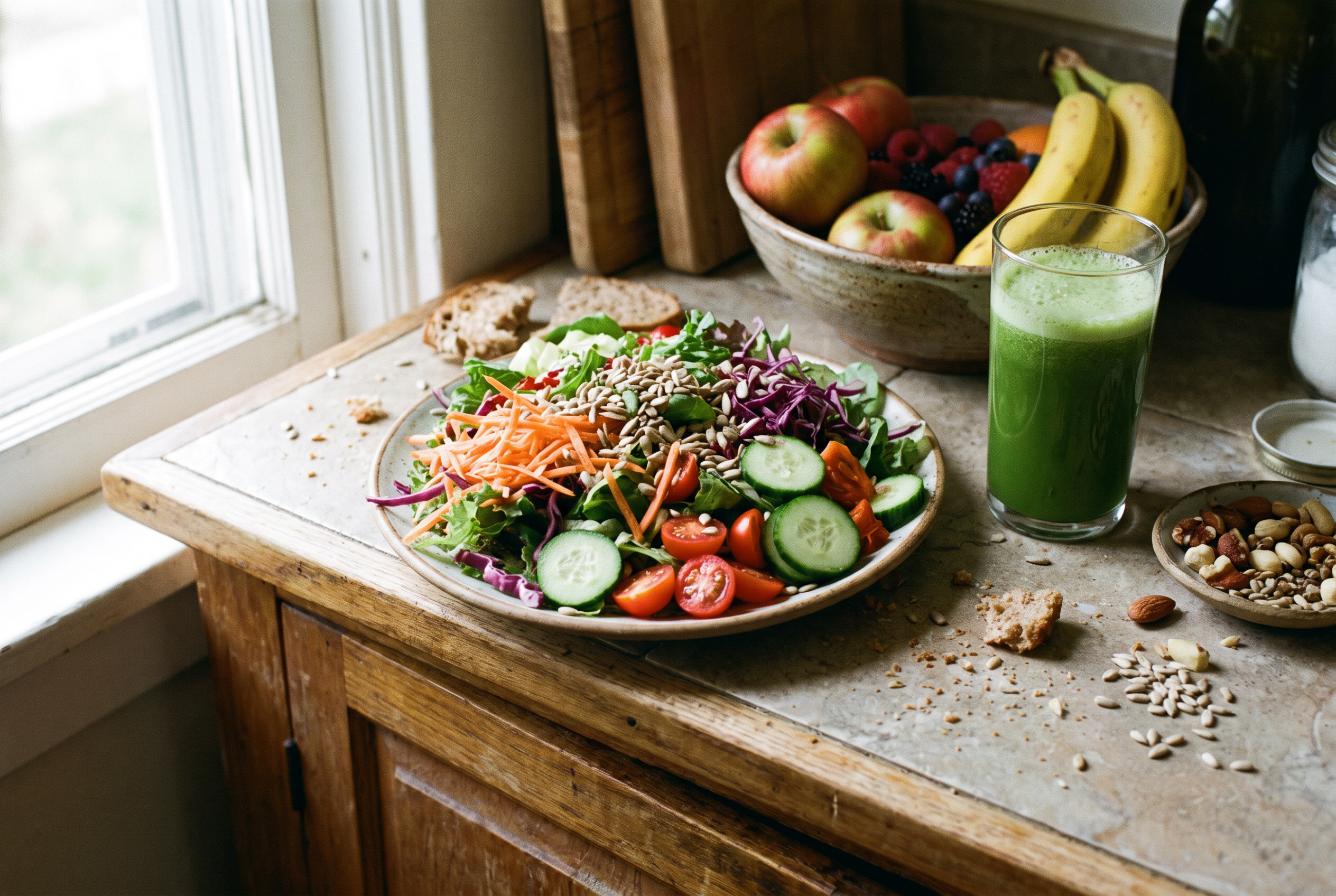
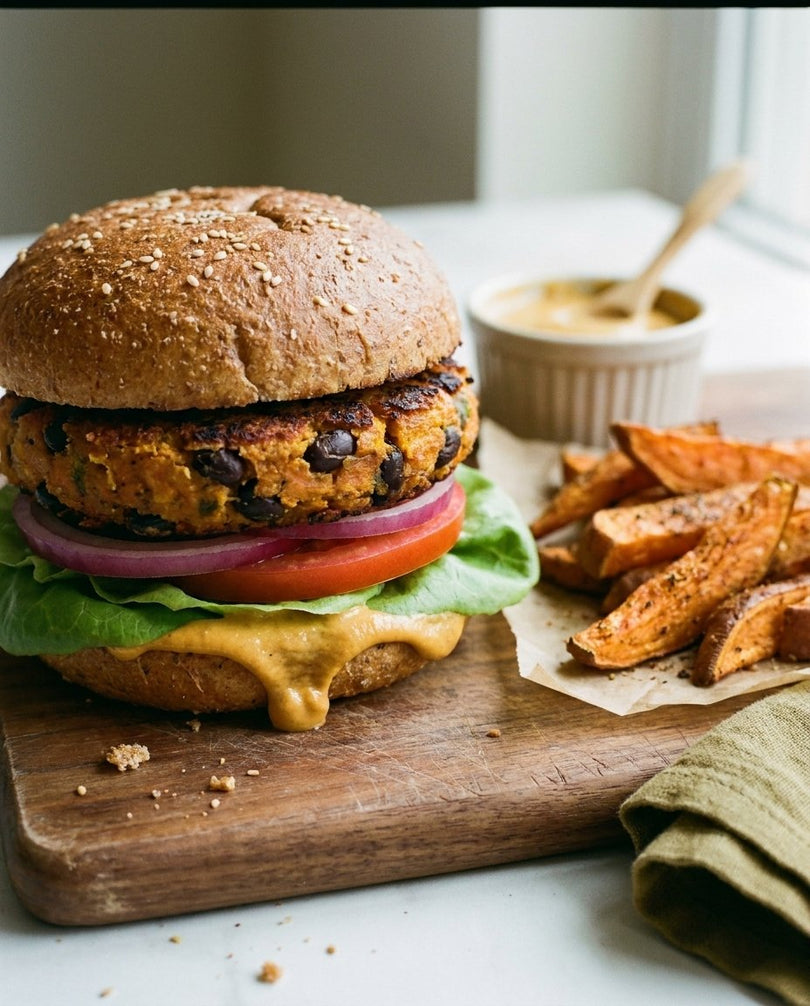
The food side has its own piece. It comes down to protein spread through the day, vitamin C for the collagen frame, calcium from the low-oxalate greens rather than from spinach and chard, vitamin K2 to put that calcium where it belongs, vitamin D mainly from sunlight, magnesium, potassium for the buffering point above, and the silicon and boron that get little attention.
Two things that are not about food:
The loading, which none of the food substitutes for. Carrying your own weight — walking, stairs, hills. Carrying something — groceries, a watering can, a grandchild. Resistance of some kind twice a week, which for most people is bodyweight work at home rather than a gym. Getting down onto the floor and back up again, which trains more than it looks like it does.
Moving joints through their whole range daily, because that is how cartilage eats.
What to notice in yourself
Getting out of a chair without using your hands. It is one of the better readouts of leg strength available, and it costs nothing to check.
Standing on one leg while you brush your teeth. Balance is a nervous-system and muscle measure, and it predicts a lot about the years ahead.
Grip. Opening jars, carrying bags. Grip strength tracks whole-body strength surprisingly well.
Morning stiffness, and specifically whether it clears within twenty minutes of moving or stays all day. The first is a lubrication matter. The second is worth more attention.
Your height, measured occasionally. And whether you have quietly stopped doing things — kneeling in the yard, carrying the suitcase upstairs — because that is usually the first sign, and it arrives as a preference rather than as a symptom.
A thought to close
The instruction bone responds to is load. Ask nothing of it and it builds nothing, and it is not being lazy. It is being economical, because maintaining structure nobody uses would be waste.
The body was made to be used, and it interprets use as the instruction to become more capable of it. Rest is built into the design as an interval, and idleness is read as information.
That puts more in your hands than a scan result suggests. The skeleton you will be walking on in ten years is being laid down this year, by what you eat and by what you ask it to carry.
Questions We Hear Most Often
Q: Is calcium the most important thing for bones?
A: It matters and it is not first. Bone is a protein frame with mineral set into it, like reinforced concrete, and the frame comes first. Dense bone with a poor frame is brittle, which is why bone can be dense and still break.
Q: Can you rebuild bone density, or only slow the loss?
A: Bone is living tissue that is removed and rebuilt continuously, and you replace roughly a tenth of your skeleton every year. Density is the running balance between those two crews, which makes it a rate rather than a verdict.
Q: Why do my joints hurt more when I rest them?
A: Cartilage has no blood supply. It is fed by joint fluid being pressed in and released as you move, so a joint that is not moved is a joint that is not fed. That is why the first few minutes of a walk are the worst and it eases after.
Q: Does vitamin K2 really matter for bones?
A: It activates the proteins that place calcium into bone, and the proteins that keep it out of arteries. Calcium arriving without it is less useful than people assume. Natto is by far the richest source, with other ferments contributing.
Q: What is the simplest way to check my strength at home?
A: Stand up from a chair without using your hands, and stand on one leg while you brush your teeth. Both cost nothing and both track a great deal about the years ahead.
Keep exploring
→ Foods That Support Bones and Joints — the food side, in more detail
→ Reserves: Why You Were Fine Until You Suddenly Were Not — why blood calcium stays normal while bone pays
→ How Your Body Works — the full library
If you would rather begin than read, our Get Started Meal Plan lays out the first week for you.
Educational content. Not medical advice.
More food-first writing: MyHDiet.com · AMPMForHealth.com
Reviewed by Olin Idol, ND, CNC — Vice President of Health, Hallelujah Diet