



Headlights that dazzle longer than they used to. Eyes that feel like sandpaper by nine in the evening. Small print that has started moving further away. Each of these has a mechanism, and two of the three are fed directly by what you eat.
Most people treat their eyes as equipment. It works, it degrades, and at some point you get a stronger prescription.
The retina is not equipment. It is nervous tissue, an outgrowth of the brain that sits at the front of your head, and it is the hungriest tissue in your body per gram. Which makes it unusually responsive to supply, and unusually exposed when supply falls short.
The retina is under constant chemical assault, by design
Consider what the retina has to tolerate. It is soaked in light. It is one of the most oxygen-rich tissues you have. And its membranes are built from the most easily oxidized fats in your body.
Light, oxygen and delicate fats together are a recipe for oxidation. The retina lives with that permanently, as the cost of doing its job, which is why it depends more heavily on antioxidant protection than almost any other tissue.
It also carries the highest concentration of DHA — an omega-3 fat — of anywhere in your body. The membranes of the light-sensing cells are built from it, and their ability to respond quickly to light depends on those membranes staying fluid. Supplied poorly, the body substitutes whatever fats are available.
And you build a light filter out of food
At the center of your retina is a small area responsible for all your detailed vision — reading, faces, fine work. Concentrated in it are two yellow pigments, lutein and zeaxanthin, packed densely into the tissue.
Your body cannot make either of them. They come entirely from food, they are absorbed from the gut, and they are then transported to the eye and deposited in exactly that spot.
Once there they do two jobs. They absorb blue light before it reaches the light-sensing cells beneath, and they act as antioxidants inside the tissue.
So you eat green leaves, and your body constructs a filter out of them and installs it in front of the most precious part of your vision. The density of that filter varies a lot between people, and it tracks what they eat. There are few clearer examples of food becoming structure.
Vitamin A is the signal itself
Seeing begins with a molecule that changes shape when light strikes it, and that molecule is built from vitamin A.
When light hits it, it bends, and that bending is the signal that becomes sight. The molecule then has to be reset before it can fire again, using more vitamin A.
That explains why the first sign of a shortfall is poor vision in dim light and slow recovery from glare. The resetting cannot keep up.
The lens is clear because its proteins are in order
The lens has no blood vessels. It would be no use if it did, and it is made of proteins arranged with extraordinary regularity. That regularity is what makes it transparent.
Two things disturb it. Oxidation, which the lens defends against with antioxidants drawn from the fluid around it. And glycation — glucose attaching to those proteins and cross-linking them, the same process that stiffens collagen. Higher average blood sugar over years disorders the arrangement, and a disordered arrangement scatters light instead of passing it through.
Dry eye is usually an oil problem
Your tear film has three layers, and this surprises people.
There is a mucin layer against the eye, a watery layer in the middle, and an oil layer on the outside that stops the water evaporating. The oil comes from small glands along the rim of your eyelids.
Most dry eye is not a shortage of water. It is a failure of the oil layer, the glands get blocked or their oil becomes too thick, the water evaporates too quickly, and the eye feels dry while producing plenty of tears. That is why drops give twenty minutes of relief and no more.
Two things make it worse. Screens, because we blink around half as often when looking at one, and blinking is what expresses oil from those glands. And dry air.
Warmth on closed eyelids helps, because it thins the oil. So does deliberate full blinking. And the omega-3 fats above change the composition of the oil itself.
Focusing is muscular, and it holds where you keep it
A muscle inside your eye changes the lens's shape to focus close up. Sustained near work keeps that muscle contracted for hours, and it fatigues like any other muscle held in one position.
The remedy is the obvious one — look at something far away, regularly. Every twenty minutes or so, twenty seconds at distance. What people actually notice is that distance vision is momentarily soft after a long stretch of close work, which is the muscle being slow to release.
Briefly, the other senses
Smell is worth paying attention to, because a gradual loss of it is one of the earliest signals the nervous system gives about anything, and it is almost always ignored. It also drives most of what we experience as taste, which is why food becomes uninteresting when it fades.
Hearing depends on hair cells that do not regenerate, and on a rich blood supply reaching them. So the circulation advice applies here too, and protecting hearing from loud noise is the only true prevention there is.
Where it commonly gets stuck
Low intake of green leaves, so the filter is thin.
Low omega-3, so retinal membranes and tear-film oil are both built from second-best materials.
High average blood sugar, which acts on the lens and on the small vessels feeding the retina.
Screens without breaks, which fatigues the focusing muscle and halves your blink rate.
Dry air.
Smoking, which is the largest avoidable factor for the eye of any on this list.
And sunlight without protection over decades, though the internal filter you eat is part of the defense.
What it needs
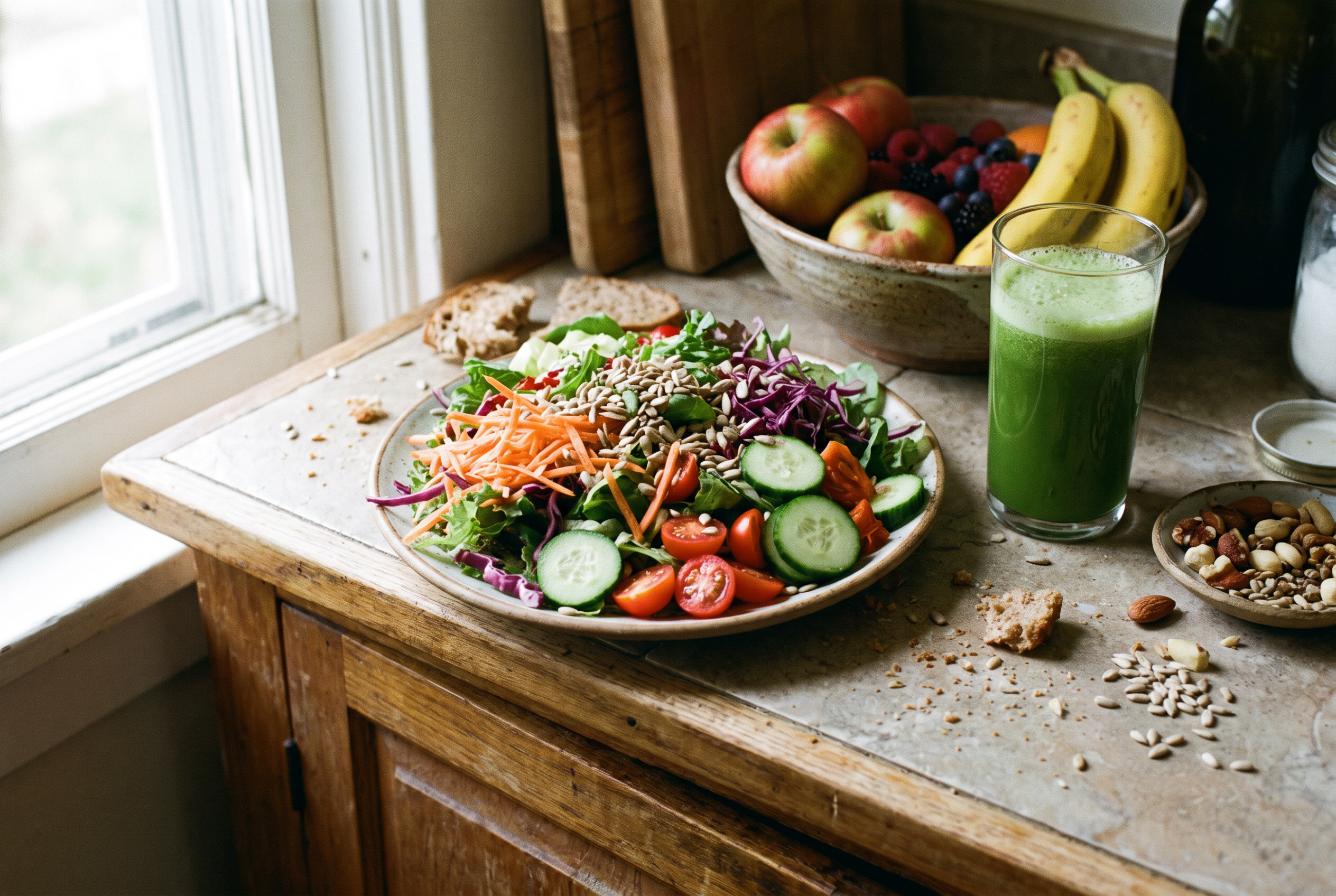
The food side has its own piece. It comes down to dark leafy greens for lutein, orange and yellow bell peppers and sweet corn for the scarcer zeaxanthin, orange vegetables for vitamin A, preformed DHA for the tissue that holds more of it than any other, dark berries for the small vessels feeding the retina, zinc, vitamin C, vitamin E and selenium, water, since the tear film starts with being hydrated, and steady blood sugar for the lens and the vessels.
One thing that is not about food:
Full blinking, and breaks from screens, per above. Blinking is what moves the oil, and a screen halves how often you do it.
What to notice in yourself
How long it takes to recover from oncoming headlights. Glare recovery is one of the better informal readouts of retinal health, and it is easy to track.
Vision in dim light, and whether it has changed.
When your eyes start feeling dry, and if it is late in the day after screen work, think oil and blinking rather than water.
Whether distance vision is soft for a moment after close work.
Your sense of smell, and whether food has become less interesting.
Whether you have started needing more light to read, which is normal with age and also tracks with the things above.
A thought to close
The first recorded act of creation was light, and the organ built to receive it turns out to be made partly of what grows under it.
A plant makes pigments to protect itself from the sun. We eat the plant, and our bodies take those same pigments, carry them to the back of the eye, and install them in front of the cells that need shielding from exactly the same light. The plant's protection becomes ours, unchanged, by the simple route of being eaten.
That is a strikingly economical arrangement, and it makes the answer short. Eat the green things. Look at something far away. Keep the line steady.
Questions We Hear Most Often
Q: Which foods are best for eye health?
A: Dark leafy greens for lutein, orange and yellow peppers for zeaxanthin, orange vegetables for vitamin A, and omega-3 for the retina and the tear film. Cook the greens with a little fat, because absorption of those pigments roughly doubles with it.
Q: What are lutein and zeaxanthin and why do they matter?
A: They are yellow pigments your body cannot make. They come entirely from food, get carried to the center of the retina, and are installed there, where they absorb blue light before it reaches the light-sensing cells beneath.
Q: Why are my eyes dry when I am producing plenty of tears?
A: Because most dry eye is an oil problem rather than a water one. The tear film has an oil layer on the outside that stops the water evaporating, and when the glands along the eyelid block, water evaporates too fast. Warmth on closed lids and deliberate full blinking help more than drops.
Q: Why do headlights dazzle me longer than they used to?
A: Glare recovery depends on a molecule built from vitamin A resetting after light strikes it. Slower recovery is one of the earliest signs that resetting is not keeping up, and it is easy to track over time.
Q: Does blood sugar affect eyesight?
A: Over years, yes. The lens is transparent because its proteins are arranged with great regularity, and glucose attaching to those proteins disorders the arrangement so it scatters light instead of passing it through.
Keep exploring
→ Foods That Support Your Eyes — the food side, in more detail
→ How Circulation Actually Works — the small vessels this tissue depends on
→ How Your Body Works — the full library
If you would rather begin than read, our Get Started Meal Plan lays out the first week for you.
Educational content. Not medical advice.
More food-first writing: MyHDiet.com · AMPMForHealth.com
Reviewed by Olin Idol, ND, CNC — Vice President of Health, Hallelujah Diet