



The liver does not need cleansing so much as supplying. It has five separate ways of packaging things for removal, and each one runs on materials that arrive from the plate.
Most of what gets sold for the liver is aimed at making it work harder. The liver is rarely idle. What limits it is running out of the things it attaches to what it is trying to remove.
Because the second half of the job is attachment. The liver takes a compound apart, and then fixes a small molecule onto the reactive fragment to neutralize it and make it water-friendly enough to leave. Five different molecules can do that attaching, by five separate routes, and every one of them is built from food.
Feed those five and the liver speeds up on its own.
Route one: sulfur
Sulfation is one of the busiest routes, used constantly on hormones and on many everyday compounds. It runs on sulfur, and sulfur runs out faster than people expect.
The cabbage family and the onion family carry most of it. Broccoli, cabbage, kale, cauliflower, Brussels sprouts, radishes, watercress, arugula. Garlic, onions, leeks, green onions, chives.
There is a second, quieter requirement here. Molybdenum is needed by the enzyme that recycles sulfur into the form the liver can use, and it is easy to be short of. Legumes are far the best source — lentils, black beans, chickpeas, peas, with oats and whole grains behind them.
Beans and broccoli, then. Unremarkable and hard to improve on.
Route two: glutathione, and the one ingredient that limits it
Glutathione is the liver's main defense and one of its main attachment molecules. It cannot usefully be eaten; the body builds it from three amino acids, and only one of them is ever in short supply.
Cysteine is the limiting one. Sunflower seeds, lentils, oats, wheat germ, sesame seeds, broccoli, Brussels sprouts and onions all supply it. The other two — glycine and glutamate — are abundant almost everywhere.
Then there are the foods that help the body recycle glutathione rather than build it, which matters because each molecule can be used repeatedly if it is restored after use. Selenium drives the enzyme that does the restoring: two or three Brazil nuts covers it, and more is not better. Riboflavin is needed for the same step — almonds, mushrooms, spinach, quinoa, nutritional yeast.
A handful of foods appear to raise the body's own glutathione production: asparagus, avocado, okra, spinach, and the cabbage family again.
Route three: the methyl route, where beets earn their reputation
Methylation attaches a small carbon group, and it is the route used heavily on hormones, including the clearing of used estrogen.
It depends on a group of nutrients that work as a set. Folate from dark leafy greens, lentils, asparagus, beans and avocado. B6 from pistachios, sunflower seeds, potatoes, bananas, chickpeas. B12, which needs a reliable source rather than hope, since no plant food provides it and absorption falls with age whatever you eat. And betaine, which is where beets come in — they are among the richest foods for it, along with quinoa, spinach and whole wheat.
Beets are the one food here most people have already heard is good for the liver. It is nice when the folk wisdom has a mechanism underneath it.
Route four: glucuronidation, and the thing that can undo it
This route attaches a sugar-like molecule, and it handles a good deal, including a large share of hormone clearance.
It has a peculiar vulnerability. Certain gut bacteria produce an enzyme that snips that attachment back off once it arrives in the intestine, which releases the compound to be reabsorbed and sent back to the liver. The liver did the work and the gut undid it.
Two things reduce that. Fiber, which shortens the time everything spends in there and binds what is heading out. And a group of compounds called glucarates, which inhibit the snipping enzyme — apples and oranges are the best everyday sources, with the cabbage family and bean sprouts contributing.
An apple a day turns out to have a specific job here.
Route five: glycine
The simplest route, used on a range of common compounds, and it attaches glycine.
Glycine is the amino acid collagen is also built from, and the richest plant sources are the same: sesame seeds and tahini, then pumpkin seeds, spirulina, beans, lentils, peanuts and oats.
Getting bile moving, so what is packaged can leave
Packaging is useless if nothing carries it out. Fat-soluble waste leaves in bile, and bile has to flow.
Bitter food starts it. Arugula, dandelion greens, radicchio, endive, chicory, watercress. Bitterness on the tongue is itself the trigger, so a few leaves at the start of a meal do more than their volume suggests.
Some fat in the meal triggers the gallbladder to release. Long stretches of very low fat eating leave bile sitting and thickening. Olive oil, avocado, tahini, nuts and seeds.
Water, because bile thickens without it.
And lemon, which is traditional, pleasant and harmless, and which gets people drinking water.
And fiber, so it does not come back
This is the step almost nobody is told about. Most bile is reabsorbed further along the intestine and returned to the liver to be used again, and what was dissolved in it can be carried back with it.
Fiber binds bile and holds on, so what left keeps going.
Ground flaxseed is the standout, and it has to be ground — whole seed passes through unopened. Then apples and pears with the skin on for their pectin, oats for beta-glucan, beans for the volume, and vegetables generally.
What to leave out, briefly
Alcohol, which jumps the line and is processed ahead of everything else.
Large amounts of fructose, particularly in liquid form, which the liver handles almost alone.
And a cleanse that mobilizes without supplying. Pushing more material into a line whose second half is short of materials is how people make themselves ill and conclude that clearing out does not suit them.
What actually helps, in practice
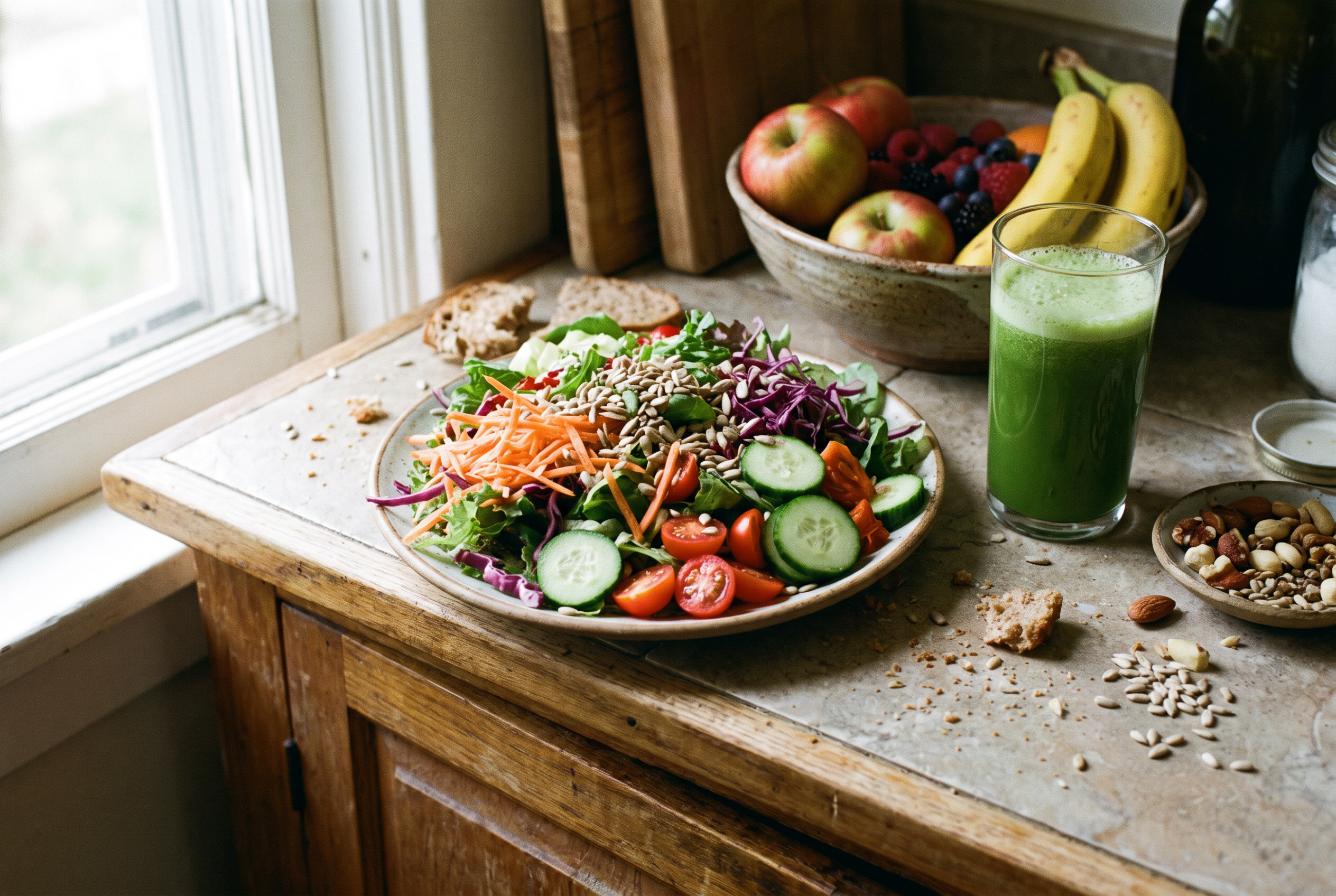
Read back over the five routes and the same foods keep appearing. Cabbage family. Onion family. Beans and lentils. Sesame and sunflower seeds. Beets. Apples. Greens, bitter where possible. Ground flax. Oats.
Start with these three:
Have something from the cabbage or onion family most days, a handful of broccoli, an onion in whatever you are cooking. Put a tablespoon of ground flaxseed into something daily, which handles the binding step nothing else does. Start your main meal with a few bitter leaves, which costs nothing and gets bile moving before the food arrives.
What to notice in yourself
How you respond to things arriving from outside — perfume, cleaning products, a glass of wine, coffee. Tolerance is the readout that usually shifts first.
Whether your morning energy improves over a few weeks, before anything else does.
Elimination, and whether it is regular and complete. The liver can only finish a job that something else carries out of the building.
Whether you feel worse rather than better when you try to clean things up quickly. That points at the second half of the line, which is the half this list feeds.
A thought to close
There is nothing dramatic on this list. Cabbage, onions, beans, seeds, beets, apples, oats, bitter leaves.
The organ that handles everything the modern world sends through you is supplied by the contents of an ordinary kitchen garden. It does not want to be flushed or challenged or put on a protocol. It wants the five small molecules it attaches to things, and something in the gut to carry out what it has finished with.
Supply that and it does the rest, which it has been doing quietly since before you knew it was there.
Questions We Hear Most Often
Q: What foods actually support the liver?
A: The cabbage and onion families for sulfur, beans and lentils for the molybdenum that recycles it, sunflower seeds and oats for the amino acid glutathione is limited by, beets for the methyl side, apples and oranges to stop packaged waste being unpacked in the gut, and ground flaxseed to carry it out.
Q: Do liver detox supplements work?
A: The liver is rarely idle. What limits it is running out of the small molecules it attaches to things before sending them out, and those come from food. Supplying them speeds it up without prompting it.
Q: Why are beets good for the liver?
A: They are among the richest foods for betaine, which supports the methyl route the liver uses heavily — including for clearing used hormones. It is pleasant when folk wisdom has a mechanism underneath it.
Q: How does fiber help the liver?
A: Most bile is reabsorbed further down the intestine and returned to the liver, and what was dissolved in it can come back too. Fiber binds bile and holds on, so what left keeps going. Ground flaxseed, apples, pears, oats and beans do it best.
Q: Is coffee bad for your liver?
A: Coffee is not the problem on this list. Alcohol jumps the processing line ahead of everything else, and large amounts of fructose — particularly in liquid form — are handled by the liver almost alone.
Keep exploring
→ What Your Liver Actually Does All Day — the two stages, bile, and why waste comes back
→ What Comes Loose Has to Go Somewhere — the exit side, in detail
→ How Your Body Works — the full library
If you would rather begin than read, our Get Started Meal Plan lays out the first week for you.
Educational content. Not medical advice.
More food-first writing: MyHDiet.com · AMPMForHealth.com
Reviewed by Olin Idol, ND, CNC — Vice President of Health, Hallelujah Diet