



Two of the pigments that protect your sight cannot be made by your body. They arrive from food, get carried to the back of the eye, and are installed in front of the cells that need shielding. You build the filter out of your lunch.
The retina is nervous tissue, an outgrowth of the brain sitting at the front of your head, and it is the hungriest tissue in the body per gram. It also lives under permanent chemical assault: soaked in light, rich in oxygen, and built from the most easily oxidized fats you have.
Which makes it unusually dependent on what arrives from the plate, in four separate ways.
The filter you eat
Lutein and zeaxanthin are yellow pigments that concentrate in the small central area of the retina responsible for all your detailed vision. Your body cannot make either one. They are absorbed from food, transported to the eye, and packed into that spot, where they absorb blue light before it reaches the cells beneath and act as antioxidants inside the tissue.
The density of that pigment varies a good deal between people, and it tracks what they eat.
Lutein comes mainly from dark leafy greens. Kale is the richest, then spinach, collards, turnip greens, parsley, arugula, broccoli and peas. Spinach is excellent here, which is worth saying plainly, because it is a poor calcium source and tends to get dismissed generally.
Zeaxanthin is the scarcer of the two and concentrates at the very center of the retina. Orange and yellow peppers are the best common source, along with sweet corn, goji berries, and orange-fleshed squash.
Both are fat-soluble, so cook the greens with a little oil or eat them with avocado, tahini or nuts. Absorption roughly doubles. Greens with no fat on them are a wasted opportunity here more than anywhere.
Cooking helps for a second reason: it collapses the volume, so a pan of wilted spinach delivers several times what the same handful raw would. Raw greens have their own merits, and for this particular job cooked wins.
The molecule that does the seeing
Sight begins with a molecule that changes shape when light strikes it, and that molecule is built from vitamin A. After it fires it has to be reset, using more vitamin A, which is why the first sign of a shortfall is poor vision in dim light and slow recovery from glare.
Sweet potato, carrots, butternut squash, pumpkin, dark leafy greens, red peppers, apricots, cantaloupe. With fat, again.
The structural fat
The retina carries the highest concentration of DHA of anywhere in your body. The membranes of the light-sensing cells are built from it, and their ability to respond quickly depends on those membranes staying fluid.
Ground flaxseed, walnuts, chia and hemp supply the plant form, which your body converts, and under one percent of it becomes DHA. For the tissue that holds more DHA than anywhere else in you, that is a thin supply line.
Fish oil is the most direct source. For anyone who would rather not take it, algae oil supplies the same molecule, algae being where the fish get theirs.
Omega-3 also changes the composition of the oil layer in your tear film, which is what actually goes wrong in most dry eye. That is the same spoonful doing two jobs.
The protection
Vitamin C sits at high concentration in the fluid inside the eye and in the lens. Peppers, black currants, strawberries, kiwi, citrus, broccoli, parsley.
Vitamin E and selenium, protecting retinal fats from oxidizing. Sunflower seeds, almonds, avocado, and two or three Brazil nuts.
Zinc, which the retina uses in large amounts and which is involved in moving vitamin A to where it is needed. Pumpkin seeds, hemp seeds, cashews, chickpeas, lentils.
The dark berries, for the small vessels feeding the retina. Bilberry has the longest history here, with black currant, blueberry and cherry alongside it.
Water, because the tear film starts with being hydrated.
The two things that cloud the lens
The lens is transparent because its proteins are arranged with extraordinary regularity, and two processes disturb that arrangement.
Oxidation, which the antioxidants above defend against.
Glycation — glucose attaching to those proteins and cross-linking them. Higher average blood sugar over years disorders the arrangement, and a disordered arrangement scatters light instead of passing it through.
It makes steady blood sugar an eye strategy, and it is not how anyone thinks of it. The whole-grain-and-beans pattern in the blood sugar piece is doing work here too.
What works against it
High average blood sugar, per above.
Smoking, which is the largest avoidable factor for the eye of anything on this list.
Low intake of green leaves, so the filter stays thin.
Screens without breaks, which is not food, we blink around half as often looking at one, and blinking is what expresses oil from the glands along the eyelid.
What actually helps, in practice
If you do three things:
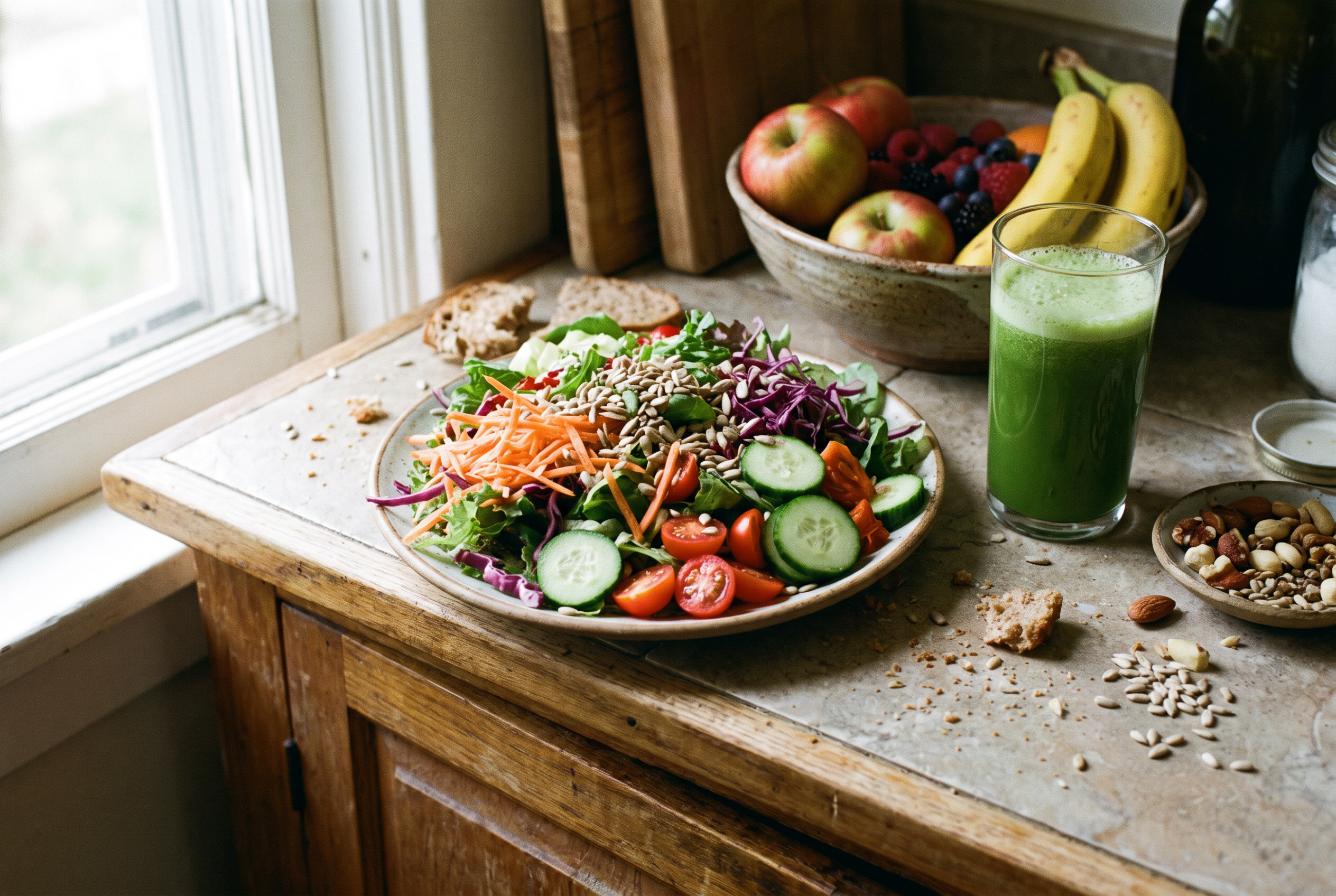
Have dark leafy greens several times a week, cooked with a little oil, which is the filter and the vitamin A together. Keep an orange or yellow bell pepper in the house for the zeaxanthin, which is the harder of the two to get. Get preformed DHA from fish oil or algae oil, which serves the retina and the tear film at once, with ground flaxseed daily alongside it.
What to notice in yourself
How long it takes to recover from oncoming headlights. Glare recovery is one of the better informal readouts of retinal health and it is easy to track.
Vision in dim light, and whether it has changed.
When your eyes start feeling dry — if it is late in the day after screen work, think oil and blinking rather than water.
Whether distance vision is soft for a moment after close work.
Your sense of smell, oddly, since a gradual loss of it is an early nervous-system signal that almost everyone ignores.
And give it months. Macular pigment builds slowly, over several months of eating this way. That is longer than most people are willing to wait, and one of the better reasons to start now.
A thought to close
Look back over this list and something unusual stands out. Almost every item on it is defined by its color.
Lutein and zeaxanthin are yellow pigments. Vitamin A arrives as orange carotene. The compounds protecting the small vessels of the retina are what make a black currant black. In this one theme, the color is the active ingredient, not a marker for it, not a sign of freshness, the substance itself.
So the eyes are the one part of the body whose nutrition you can identify by looking. Dark green, deep orange, red, purple, black. No label, no analysis, no need to know a single nutrient name.
For an organ whose whole business is light and color, being fed by light and color seems a fitting arrangement, and a convenient one, since it means the instruction fits in four words. Eat the colored things.
Questions We Hear Most Often
Q: Which foods are best for eyesight?
A: Dark leafy greens for lutein — kale most of all — and orange or yellow bell peppers for zeaxanthin, which is the scarcer of the two. Then orange vegetables for vitamin A, berries for the small vessels, and preformed DHA for the retina and the tear film.
Q: Do I need to cook greens for eye health?
A: Cooking helps twice. These pigments are fat-soluble, so a little oil roughly doubles absorption, and cooking collapses the volume so a pan of wilted spinach delivers several times what the same raw handful would.
Q: Is spinach good for your eyes?
A: Excellent, and worth saying because spinach gets dismissed generally for being a poor calcium source. For lutein it is one of the best things you can eat.
Q: What helps dry eyes?
A: Most dry eye is a failure of the oil layer on the tear film rather than a shortage of water, which is why drops give twenty minutes of relief. Omega-3 changes the composition of that oil, and warmth on closed lids plus deliberate full blinking help mechanically.
Q: How long before eye-friendly foods make a difference?
A: Months. Macular pigment density builds slowly over several months of consistent eating, which is longer than most people want to wait and a good reason to start now.
Keep exploring
→ You Build Your Own Sunglasses Out of Green Leaves — the retina, the lens, and why dry eye is an oil problem
→ Energy Is Not a Quantity. It Is a Steady Line. — why steady blood sugar protects the lens
→ How Your Body Works — the full library
If you would rather begin than read, our Get Started Meal Plan lays out the first week for you.
Educational content. Not medical advice.
More food-first writing: MyHDiet.com · AMPMForHealth.com
Reviewed by Olin Idol, ND, CNC — Vice President of Health, Hallelujah Diet