




Two people catch the same thing. One is over it in three days, the other is still coughing in March. The difference is rarely how strong their immune systems are. It is how well each one judges, escalates, and then stops.
Every winter someone asks us how to boost their immune system, and we understand exactly what they mean. What they are describing is an aim nobody actually wants if they think it through.
An immune system turned up is not a healthier one. Allergy is an immune system reacting to pollen as though it were an invasion. An autoimmune condition is one attacking the body it belongs to. Neither is weakness.
What you want is an immune system with good judgment. One that knows what belongs, reacts fast and hard to what does not, and then stands down properly when the job is finished.
Most of it is a wall
The dramatic part of immunity is the fighting, and the largest part is keeping things out in the first place.
Your skin is a sealed barrier that is also mildly acidic and carries its own population of resident bacteria, which crowd out anything arriving.
Your airway is lined with mucus and with cells carrying tiny beating hairs that move that mucus steadily upward and out. You swallow the day's catch without noticing.
Your gut lining is the biggest interface you have with the outside world — roughly the area of a studio apartment, folded into your abdomen, one cell thick in places. Everything you eat presses against it.
Barriers do not make anybody feel protected because nothing happens when they work. A person who never gets ill assumes they have a strong immune system, and usually what they have is intact walls.
When something gets through, two systems answer
The fast one answers immediately. It does not know what it is dealing with and does not need to. It responds to anything with the general shape of trouble. Fever, swelling, heat, mucus, fatigue. That system is the reason you feel ill. The symptoms are the response rather than the infection.
Fever deserves a word. Raising your body temperature is deliberate, it is expensive, and it slows the reproduction of most things that infect us while speeding your own defenses up. A moderate fever is the system working as designed.
The slow one answers specifically. Over days it identifies the exact intruder, builds a precise tool against it, and keeps the blueprint. That is memory, and it is why you get chickenpox once. It takes about a week the first time and hours the second.
Inflammation is the tool, and the skill is switching it off
Inflammation gets talked about as though it were the problem. It is the escalation — increased blood flow, fluid, and immune cells arriving where they are needed. Without it nothing would heal.
The part that matters is this: resolution is an active process. The body does not simply stop inflaming. It produces a separate set of signaling compounds whose job is to shut the response down, clear the debris and switch the tissue back to repair. Those compounds are built from omega-3 fats.
So a body short of omega-3 fats, carrying a high standing load, and never getting a proper stretch of rest tends to inflame appropriately and then fail to fully stand down. What you get is a low-grade response that never quite finishes, which is a fair description of a great many modern complaints.
The lymphatic system, which has no pump
Blood has a heart behind it. Lymph does not, and there is more lymph in you than blood.
Fluid leaks continuously out of your capillaries into the spaces between cells: that fluid is how your tissue is bathed and fed. It has to be collected and returned, and the lymphatic vessels are what collect it. They run alongside your veins with one-way valves, and they move for one reason: they get squeezed by the muscles around them.
Every step you take, every breath that moves your diaphragm, every time you stretch or roll your shoulders, you are pumping lymph. Sit still and it more or less stops.
Along the way the fluid passes through lymph nodes, which are checkpoints. Immune cells sit there sampling what comes past, which is why nodes in your neck swell when you have a sore throat. Something is being examined.
It is the most neglected part of immunity and the cheapest to address. A body that does not move has an immune surveillance system running slowly, and no supplement changes that.
And the gut, which is where the judgment is trained
Something like seventy percent of your immune tissue sits around your intestine, and once you know that, the placement makes obvious sense. That is the border with the highest traffic.
The immune tissue there is doing the hardest job in immunity — deciding what to tolerate. Food has to be allowed. The bacteria that live there have to be allowed. A pathogen arriving in the same mouthful has to be stopped. Getting that wrong in either direction is a problem.
Your gut bacteria are part of how that calibration happens. A varied population, fed on fiber, keeps the immune tissue there educated and keeps the lining fed. A thin population on a low-fiber diet leaves it less well-trained and the lining less well-supplied.
Where it commonly gets stuck
Short or broken sleep. Much of the immune system's work happens at night, and a run of bad nights measurably reduces how well you respond to a challenge.
Sitting still, which slows lymph.
A nervous system that never downshifts. Sustained cortisol suppresses parts of the response and disinhibits others, so the picture becomes less accurate rather than simply weaker.
A compromised gut lining, from low fiber, alcohol, or long stretches of processed food. Weaken the wall and more gets through to be dealt with.
Shortfalls of the specific nutrients the system spends. Zinc and vitamin D are the two most commonly short, and both are used directly in immune signaling.
A high standing load, which keeps the response partly switched on and leaves less capacity for anything new.
What it needs
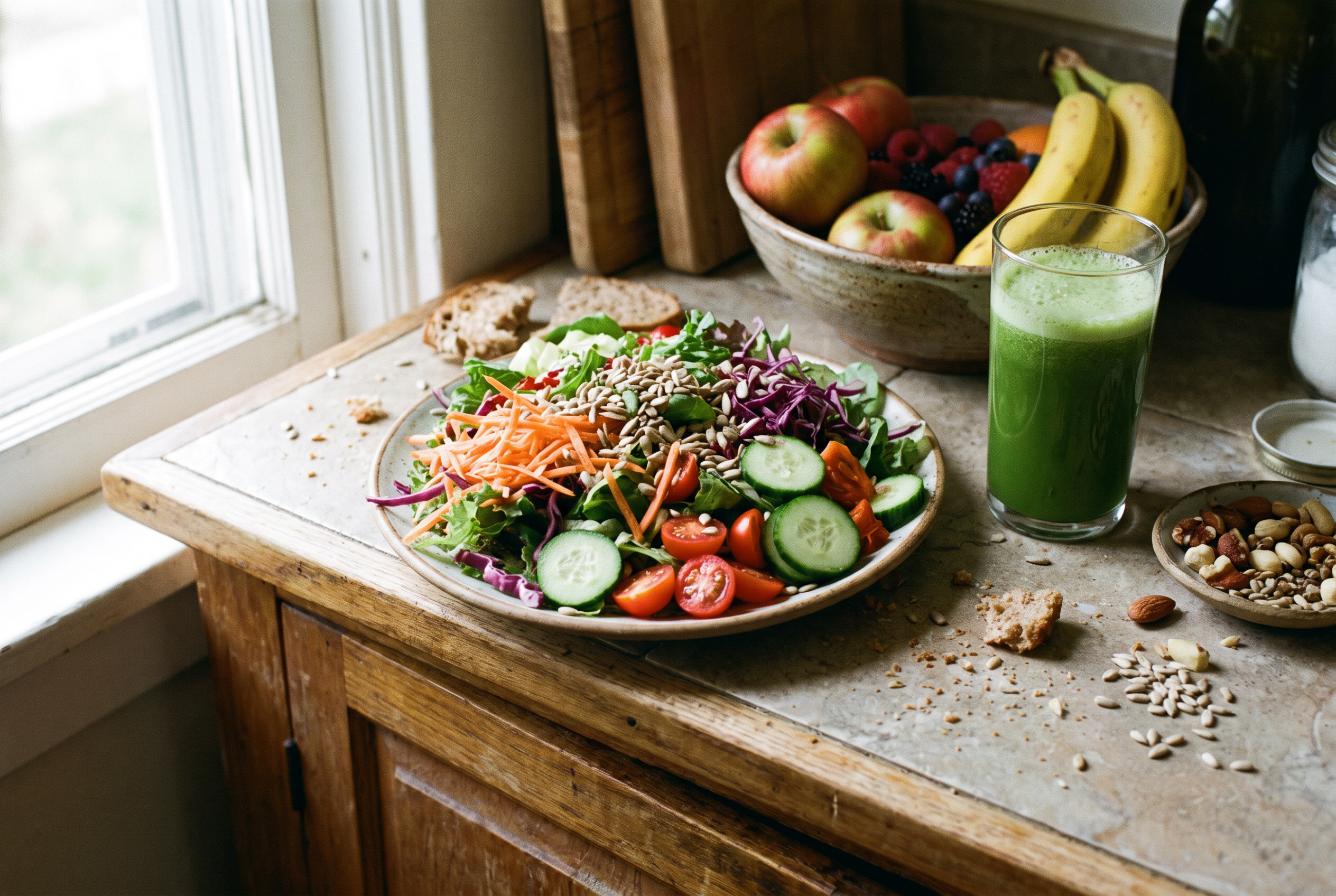
The food side has its own piece. It comes down to zinc, which every immune response spends, vitamin C, which is spent continuously and stored barely at all, vitamin A for the barriers themselves, vitamin D mainly from sunlight, selenium for the enzymes that protect immune cells from the oxidative stress of their own work, mushrooms for the beta-glucans, alliums and deeply colored plants and ferments, omega-3 for the resolution side, and fiber at volume, because it feeds the bacteria that train the judgment.
One thing that is not about food:
Movement, which is the lymphatic pump. Walking. Standing up every half hour. Anything that moves your diaphragm properly — singing counts, which is a pleasant thing to be able to say.
What to notice in yourself
How often you catch things, and separately, how long they take to finish. The second is more informative. A three-day cold and a five-week cough can start from the same virus.
Whether you run a fever when you are ill. An adult who never does may be worth thinking about, because a fever is a capability.
Swollen glands in your neck, and whether they settle afterward. Morning stiffness, which is often a resolution problem rather than a joint problem. Whether cuts and scrapes close on the timetable they used to.
How you feel after a week of five-hour nights, since that is the single variable most likely to be behind a bad winter.
A thought to close
Scripture asks repeatedly for discernment — the ability to tell one thing from another, what to receive and what to refuse. “Solid food belongs to those who are of full age, that is, those who by reason of use have their senses exercised to discern both good and evil.” (Hebrews 5:14) It is asked for far more often than strength is.
The immune system is that request written into tissue. Its entire task is to know what belongs and what does not, to act decisively, and to stop when the work is done. Get it wrong by being too quiet and you are overrun. Get it wrong by being too loud and you attack the house you live in.
Which suggests the aim is accuracy rather than strength. And accuracy comes from the unglamorous things — sleep, movement, intact walls, and enough of what the system spends when it works.
Questions We Hear Most Often
Q: Can you actually boost your immune system?
A: Not in the way the word suggests, and you would not want to. An immune system reacting more readily is what hay fever is. What you want is one that judges accurately, acts hard, and then stands down properly.
Q: Why does every cold turn into a five-week cough?
A: Inflammation does not simply fade; the body produces a separate set of compounds whose job is to shut the response down and clear up afterward. Those are built from omega-3 fats. Short of them, a response finishes appropriately and then fails to fully stop.
Q: Should I be worried if I never run a fever?
A: A fever is a capability rather than a symptom. Raising body temperature is deliberate and expensive, and it slows most things that infect us while speeding your own defenses. An adult who never runs one is worth thinking about.
Q: Why does my immune system depend on my gut?
A: Around seventy percent of your immune tissue sits along your intestine, because that is the border with the highest traffic. The bacteria living there help train it to tell food and residents from intruders, and those bacteria are fed by fiber.
Q: What does the lymphatic system have to do with immunity?
A: Lymph carries fluid and immune cells around the body and has no pump of its own. It moves only when the muscles around its vessels squeeze it. Walking, stretching and deep breathing are the pump, so sitting still slows immune surveillance.
Keep exploring
→ Foods That Support Your Immune System — the food side, in more detail
→ How Digestion Actually Works — the border where most of this is decided
→ How Your Body Works — the full library
If you would rather begin than read, our Get Started Meal Plan lays out the first week for you.
Educational content. Not medical advice.
More food-first writing: MyHDiet.com · AMPMForHealth.com
Reviewed by Olin Idol, ND, CNC — Vice President of Health, Hallelujah Diet