



Long before anyone put GLP-1 in an injection pen, your body was making it.
A few minutes into every meal, cells in the lining of your gut release it. It tells your brain you've had enough. It slows your stomach so the meal stays with you. It helps your pancreas send out insulin in proportion to the food in front of you. It is one of the ways you were designed to know when to stop eating, and to feel steady once you have.
When that system works, nobody thinks about it. You eat, you're satisfied, and you get on with your afternoon. When it stops working well, life feels like a constant negotiation with your appetite. Researchers have known for decades that the gut's hormone response to a meal is weaker in many people with type 2 diabetes, and the people who struggle most with hunger and weight are usually the ones who have been eating, for years, the food that does the least to activate it.
That's the part of this conversation that gets lost. The weekly shots everyone is talking about hold the GLP-1 signal high from the outside, for as long as you keep taking them. Food works on the system that makes the signal in the first place. If you want something that lasts, that's where to put your effort, and it starts on your plate.
The Short Version
These are the habits that do the most to support your body's own GLP-1 and fullness signals:
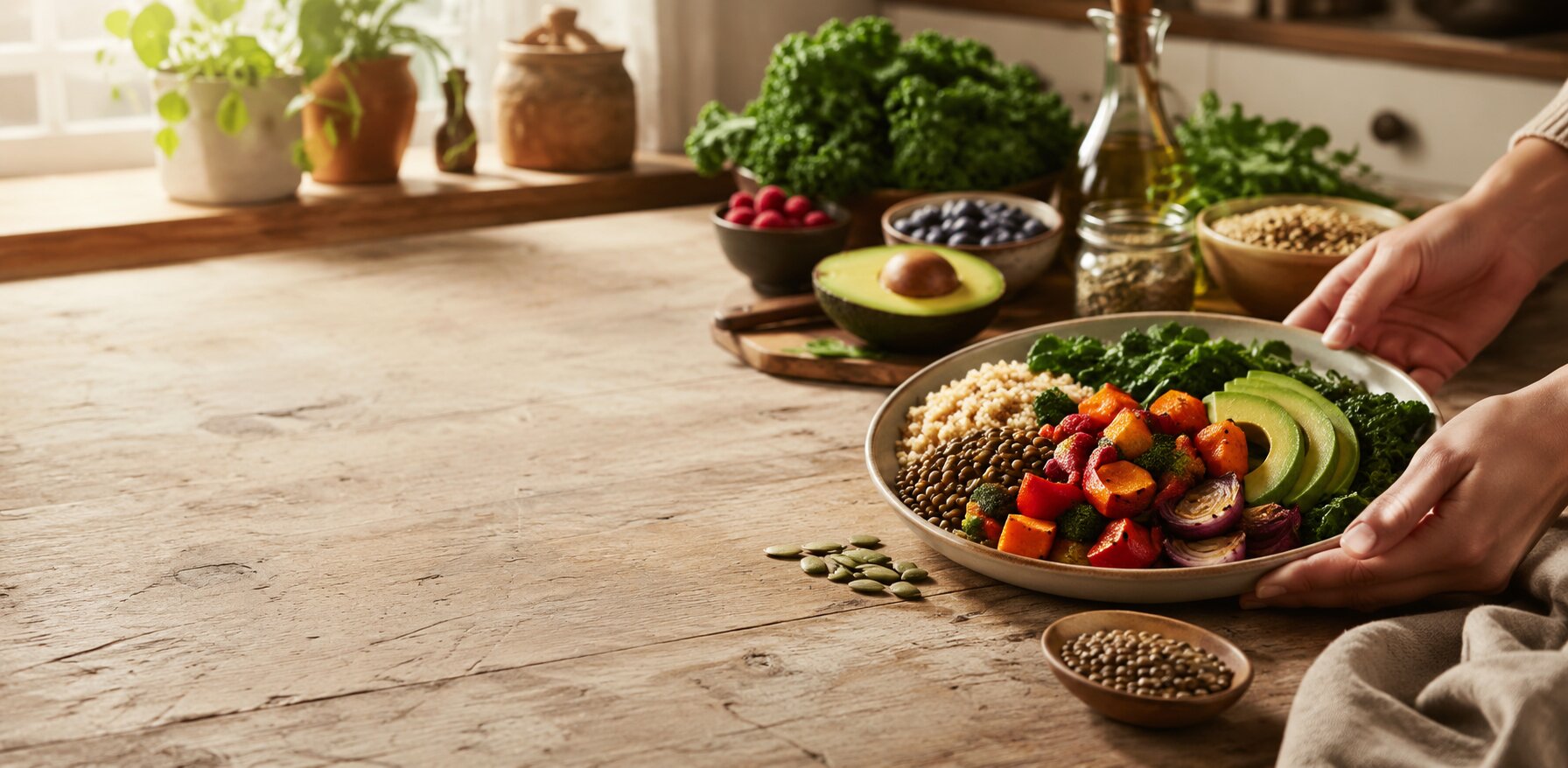
- Fiber from whole plants, every day: beans, lentils, oats, barley, onions, garlic, and plenty of vegetables.
- Vegetables first, starch last: the order you eat in changes how your body responds.
- Whole food over processed food: food your gut has to work for.
- Protein on purpose at each meal: beans, lentils, seeds, nuts, quinoa.
- Slow down: fullness takes about twenty minutes to arrive.
The rest of this article explains why each one works.
Where GLP-1 Is Made, and Why Most Food Never Gets There

The cells that make GLP-1 are called L-cells, and most of them sit far down your digestive tract, in the lower part of the small intestine and in the colon. To get a strong signal, food has to make it that far.
Most of what Americans eat doesn't. Think about what happens to food before it reaches your table. Wheat is milled into fine white flour. Fruit is pressed into juice and the fiber thrown away. Crackers, chips and snack bars are designed to melt in your mouth. That food has, in effect, been half digested in a factory. Your body absorbs it quickly, near the top of the small intestine, and very little of it ever travels far enough to reach the cells that send the "enough" message.
Whole food is different. A bowl of lentils, a big salad, a pot of barley soup, an apple with the skin on: these arrive with their structure intact. The fiber and the plant's own cell walls slow digestion down, so part of the meal makes the long trip to where the L-cells are waiting.
A well-known study at the National Institutes of Health showed what that looks like in real life. Researchers housed 20 adults on a hospital ward for a month. For two weeks they were offered ultra-processed meals, and for two weeks unprocessed meals, matched for calories, sugar, fat, fiber and salt. Everyone could eat as much as they liked. On the processed food, people ate about 500 more calories a day and gained weight. On the whole food, they lost weight without trying. During the whole-food weeks, a fullness hormone made by the same gut cells that make GLP-1 ran higher, and the main hunger hormone ran lower.
Same people, same ward, same freedom to eat. The only thing that changed was the food, and their bodies started telling them they'd had enough.
Our article on intact whole grains and blood sugar goes further into why the same grain behaves so differently whole than ground.
What the Shot Does, and What It Leaves Untouched
The GLP-1 your body makes lasts about two minutes in the bloodstream before an enzyme breaks it down. That's by design. It rises with a meal, does its work and clears.
The medications are built to resist that breakdown and stay active for about a week. They hold the signal high around the clock, whatever you eat. For many people that brings their appetite down dramatically, and they lose weight.
What they don't do is change the food that weakened the system in the first place. When people stop, the signal goes back to whatever the body is producing on its own, and if the diet underneath never changed, neither has that. In one major trial that followed people after they stopped, most had regained about two-thirds of the weight they'd lost within a year, and the improvements in blood pressure and blood sugar faded along with it. That isn't a failure of willpower. It's cause and effect. The cause was never addressed.
That's why we keep coming back to the plate. A body that is fed whole, fiber-rich, living food has a fullness system with something to work with, meal after meal, for the rest of your life. Here is what that looks like, starting with the change that matters most.
Fiber Feeds the Bacteria That Send the Signal

If you change only one thing, make it fiber, especially the kinds your gut bacteria can ferment.
When that fiber reaches the colon, the bacteria living there break it down and produce compounds called short-chain fatty acids. The L-cells have receptors for those compounds, and when they detect them, they release GLP-1 and its partner hormone PYY. In other words, feeding the bacteria in your gut is one of the ways you feed your fullness signal.
A small study from Sweden shows how quickly this can happen with ordinary food. Twenty healthy middle-aged adults ate bread made from whole barley kernels for three days. The next morning, their fasting GLP-1 was about 56 percent higher than after three days of white wheat bread, and their blood sugar rose less after breakfast. Breath tests showed their gut bacteria had been busy fermenting the barley.
Most American adults eat about 15 grams of fiber a day, roughly half of what they need. Closing that gap may be the most useful single change for most people reading this.
The foods that do this work:
- Beans, lentils, chickpeas and split peas, which bring fiber and protein in the same bite
- Oats and barley, whole, steel-cut or rolled rather than instant
- Onions, garlic, leeks and asparagus, natural sources of a fiber gut bacteria especially love
- Cooked-and-cooled potatoes, rice and beans, since cooling forms a starch that behaves like fiber
- Ground flaxseed and chia, easy to add to almost anything
- Raw sauerkraut and other fermented vegetables, which bring living bacteria along with the fiber
- Apples, pears and berries, eaten whole with the skin on
- Vegetables of every kind, raw and cooked
If you've been eating very little fiber, add it gradually and drink more water as you go. Going from 12 grams to 40 overnight is a good way to spend a week feeling bloated and deciding fiber isn't for you. Our guide to foods that steady your energy walks through how several of these work on blood sugar.
Eat Your Vegetables First and Your Starch Last

This is the simplest change on the list, and one of the best studied.
Researchers at Weill Cornell Medicine gave people the same meal on different days and changed only the order they ate it in. When the vegetables and protein came first and the carbohydrate came last, blood sugar rose roughly half as much, the insulin response was lower, and the GLP-1 response was higher. Same food. Different order.
People who have followed the Hallelujah Diet for any length of time will recognize this. A large salad has been the center of lunch and dinner in this way of eating for decades. Eating it first, before anything else touches the plate, is a very small step from there.
Protein on Purpose

Protein at a meal brings a stronger and longer feeling of fullness than the same amount of refined starch.
On a plant-based plate, protein has to be deliberate. Beans and lentils are the easy answer, because they bring protein and fermentable fiber together and do two jobs on this list at once. Add seeds, nuts, quinoa, hemp hearts, and tofu or tempeh, and put some in every meal rather than hoping it shows up. Our list of the best high-protein plant foods is a good place to start.
Slow Down

In one study, volunteers ate the same meal twice, once in five minutes and once over thirty. The slow meal produced higher levels of both GLP-1 and PYY afterward.
Fullness hormones rise over the course of a meal, not with the first bite. If you finish before they've had time to climb, you've eaten past the point where your body would have said "enough."
Put your fork down between bites. Sit at a table instead of standing at the counter or eating in the car. Chew your food properly; it's the one stage of digestion entirely under your control, as we explain in how digestion actually works. Whole food helps on its own here, because nobody eats a big salad or a bowl of lentil stew in five minutes.
If You're Taking One Now
Plenty of people reading this are on one of the GLP-1 medications, or love someone who is. Nobody should feel ashamed of that. If that's you, what you eat matters more right now, not less.
These medications work largely by helping you eat less, often a lot less. When intake drops that far, every bite has to carry more. Research on people taking them has found many fall well short on fiber, protein and several vitamins and minerals, and that a meaningful share of the weight lost can come from muscle rather than fat.
- Make the smaller plate count. Vegetables, beans, lentils, whole grains, nuts and seeds pack the most nourishment into the least room.
- Eat your protein early in the meal, so it doesn't get crowded out when you fill up quickly.
- Get fiber and water every day. These medications slow digestion, and fiber with plenty of fluid helps keep things moving. Build it up slowly.
- Know your numbers. A nutritionally minded health care professional can check vitamin D, iron and B12 and look at whether you're getting enough protein.
Most of all, use this season to build the habits in this article. They are what will still be there doing the work for you, whatever comes next.
A Fullness-First Day
This isn't a meal plan, just a picture of how it fits together.
Breakfast: Steel-cut oats with ground flaxseed, walnuts and berries, with a glass of BarleyMax alongside.
Lunch: A big salad first, with greens, raw vegetables, chickpeas and pumpkin seeds. Then a cup of lentil or split pea soup.
Afternoon: An apple with almond butter, eaten slowly.
Dinner: Vegetables first, raw or steamed. Then black beans with peppers and onions over barley or brown rice that was cooked earlier and reheated, with a forkful of raw sauerkraut on the side.
To see a full day the way we actually eat it, what a day on the Hallelujah Diet looks like lays it out meal by meal.
Where to Start This Week
- Add one serving of beans or lentils a day. Soup, salad, wrap or side, wherever it fits.
- Eat your vegetables first at lunch and dinner.
- Swap one refined grain for a whole one, like barley or steel-cut oats in place of white bread or instant cereal.
- Put protein in every meal on purpose.
- Take twenty minutes for dinner. Sit down and slow down.
- Raise fiber gradually, and drink more water as you go.
Nothing on that list takes anything away. Add the good things first, and the rest tends to sort itself out. It's the same principle behind "Replace Before You Eliminate."
Fullness Was Built In
"And God said, Behold, I have given you every herb bearing seed, which is upon the face of all the earth, and every tree, in the which is the fruit of a tree yielding seed; to you it shall be for meat." Genesis 1:29
Seeds, grains, beans, fruit and green plants. Read that list now and it's almost exactly the list of foods that feed the fullness system we've been describing. The fiber, the protein, the whole structure that carries a meal far enough to be noticed: it was in the provision from the first page.
Scripture also says, "When thou hast eaten and art full, then thou shalt bless the LORD thy God" (Deuteronomy 8:10). Being full was never the problem. It was meant to be part of the gift. If you've spent years feeling like your appetite was something to fight, it may help to know your body was designed to tell you when it's been well fed, and that the food you were given helps it say so.
The Fullness Foods List
If you'd like all of this on one page, we've put it together for you: the foods that do the most for fullness, grouped so you can shop from it, with the vegetables-first meal order on the back. It's free, and it's made for the refrigerator door.

Questions We Hear Most Often
Q: Can I raise my GLP-1 naturally?
A: You can support the GLP-1 your body already makes. The cells that produce it sit far down the gut and respond to food that arrives intact, especially fiber your gut bacteria can ferment. Beans, lentils, oats, barley, vegetables and other whole plant foods, eaten vegetables-first and slowly, give that system the most to work with.
Q: What foods help the body make GLP-1?
A: Foods rich in fermentable fiber do the most: beans, lentils, chickpeas, oats, barley, onions, garlic, cooked-and-cooled potatoes or rice, and raw fermented vegetables. Protein at each meal and whole rather than processed food also help, along with eating your vegetables first and taking your time.
Q: Why does processed food leave me hungry?
A: Flour, juice and snack foods are broken down so thoroughly before you eat them that your body absorbs them near the top of the small intestine. Very little reaches the cells farther down that release your fullness hormones. In a National Institutes of Health study, people offered processed food ate about 500 more calories a day than when offered whole food.
Q: Why does weight come back after people stop GLP-1 medications?
A: The medication holds the fullness signal high from the outside, but it doesn't change the diet underneath. When it stops, the body goes back to producing its own signal, and if the food hasn't changed, neither has that signal. In one major trial that followed people after stopping, most regained about two-thirds of the weight they had lost within a year.
Q: I'm on a GLP-1 medication. What should I be eating?
A: Because these medications help you eat much less, the food you do eat needs to work harder. Focus on vegetables, beans, lentils, whole grains, nuts and seeds; eat protein early in the meal; and get enough fiber and water every day. A nutritionally minded health care professional can help you check protein and key nutrients like vitamin D, iron and B12.
Q: Does the order I eat my food in really matter?
A: In small studies, eating vegetables and protein before carbohydrates cut the rise in blood sugar after a meal roughly in half and produced a stronger GLP-1 response than eating the same carbohydrates first. Salad and vegetables first, then beans or other protein, then bread, rice, potatoes or fruit.
You Might Also Like
- Why Your Energy Crashes, and How to Steady It — what's happening in the blood sugar swing, and why the bottom of it is what you feel
- Foods That Help Digestion, and Why Each One Works — fiber, ferments, and the stages of digestion they support
- Why You Feel Off When Your Labs Come Back Normal — when nothing is technically wrong, but nothing feels right either
- What the Bible Actually Says About Food — the design for nourishment, straight from the text
We offer these teachings freely to support clarity, stewardship, and responsible care. If this article was helpful, you may explore additional resources here:
- MyHDiet.com — plant-based nutrition, enzymes, detox foundations
- WipeOutToxins.com — toxin-free living and prevention
- CleanseYourBlood.com — circulation and blood-flow support
- HealthRetreat.com — Hallelujah Diet Health Retreat
- AMPMForHealth.com — everyday wellness rhythms and curated tools
Thank you for being part of a community committed to thoughtful, responsible care.