


A word travels in a particular way. It starts somewhere far from you — in this case a weight room, thirty years ago, among young men who wanted to lift more than they could lift. Then a daughter mentions it. Then a woman at church says she has started taking it. And one morning it arrives at your own kitchen table, and you find yourself wondering whether a thing built for athletes has anything to say to a woman of fifty-eight who has never thought of herself as one.
Creatine is that word right now. And it does have something to say to her. A smaller something than the enthusiasm around it suggests, and in a direction most of the conversation misses.
Your body already makes it
Before any of this becomes a question about a jar on a shelf, it helps to know that creatine is not foreign to you. You are making it right now.
Your liver, kidneys and pancreas assemble it out of two amino acids, glycine and arginine, at a rate of roughly a gram a day (Nutrients, 2025). Most of it ends up stored in muscle, where it does something quite specific: it helps muscle cells recycle the energy they have just spent, so that a short, hard effort can keep going a moment longer than it otherwise would.
That is the whole mechanism. It puts energy back faster.
Where the plant-based plate sits in this
A typical mixed diet supplies another one to two grams a day on top of what the body makes. Plant foods contain negligible amounts, so a woman eating the way we eat is running on what her own body produces and very little else. That shows up when researchers look — lower in muscle, and lower in serum, plasma and red blood cells (Nutrients, 2025).
Lower is not the same as lacking. Your body makes what it needs to get through an ordinary day, and it has been doing so your whole life. The gap only becomes visible when you ask muscle for something hard and brief — standing up from the floor with a grandchild on your hip, carrying groceries up a flight of stairs, the fourth repetition when three was all you had planned.
What the research in postmenopausal women actually found
A review published this year in the Journal of the International Society of Sports Nutrition gathered seven randomized trials covering 608 postmenopausal women, running between twelve and 104 weeks, with a median of thirty-eight (JISSN, 2026).
Where women took at least five grams a day alongside resistance training, two things moved:
- Lean mass went up by 0.37 kg on average
- Leg-press strength went up by 7.5 kg on average
Bone density did not change. And the trials that used smaller amounts showed nothing at all.
Those numbers are smaller than the conversation around them. A little over three-quarters of a pound of lean tissue, gained across the better part of a year, is a modest return. The strength figure carries more weight: roughly sixteen and a half pounds more on a leg press is the difference between a chair you can rise from and a chair you cannot. Bone did not move at all, and whatever creatine is doing, it is not doing that.
In every one of those trials, creatine was paired with resistance training. Nobody got stronger sitting still with a glass of it. The training was the stimulus; the creatine made the training go slightly further. Take the training away and there is nothing in this literature to report.
Food first, and what that means here
The body builds creatine out of glycine and arginine, with a methylation step that draws on methionine. Those are the raw materials, and they come off a plant.
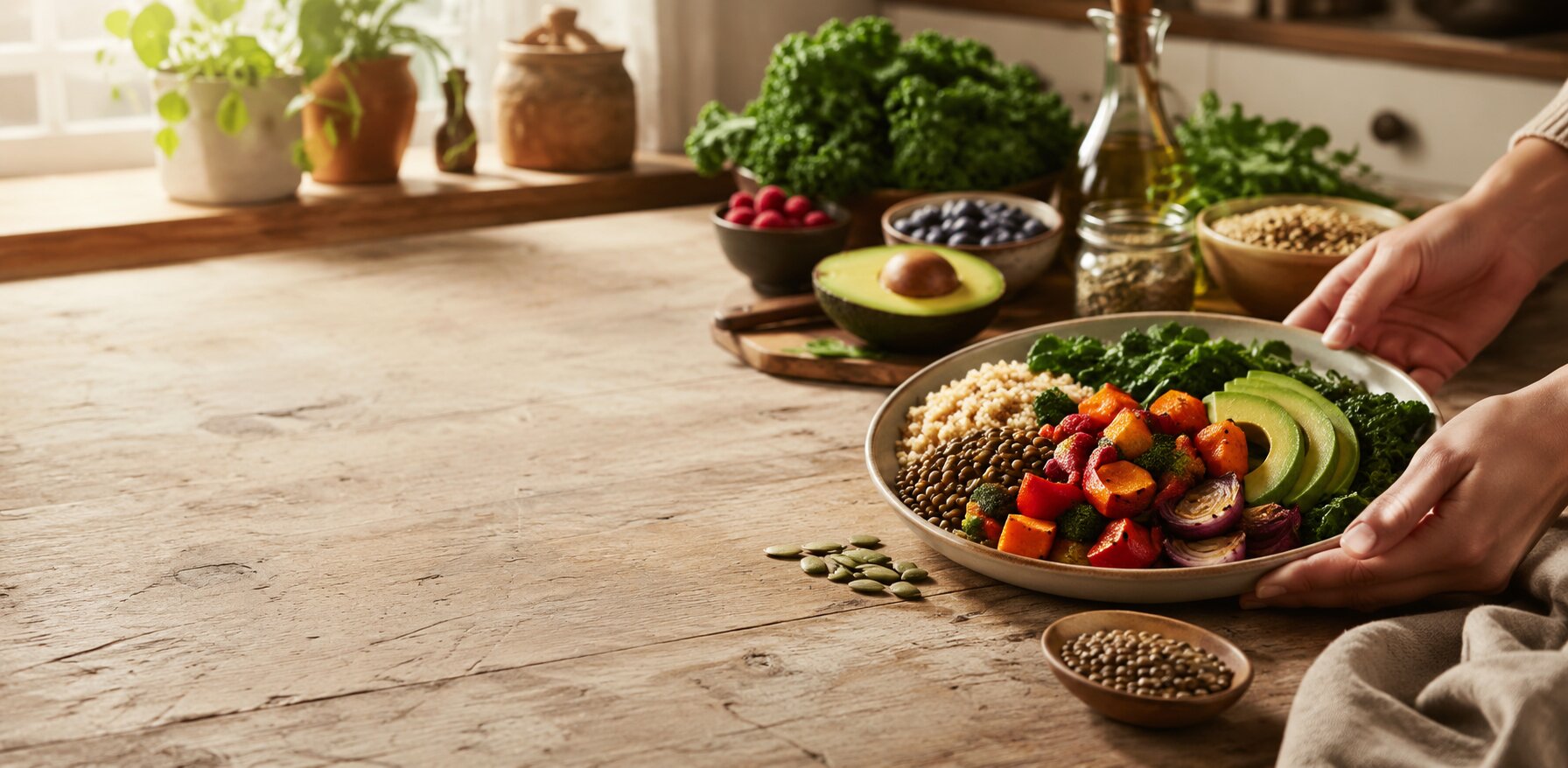
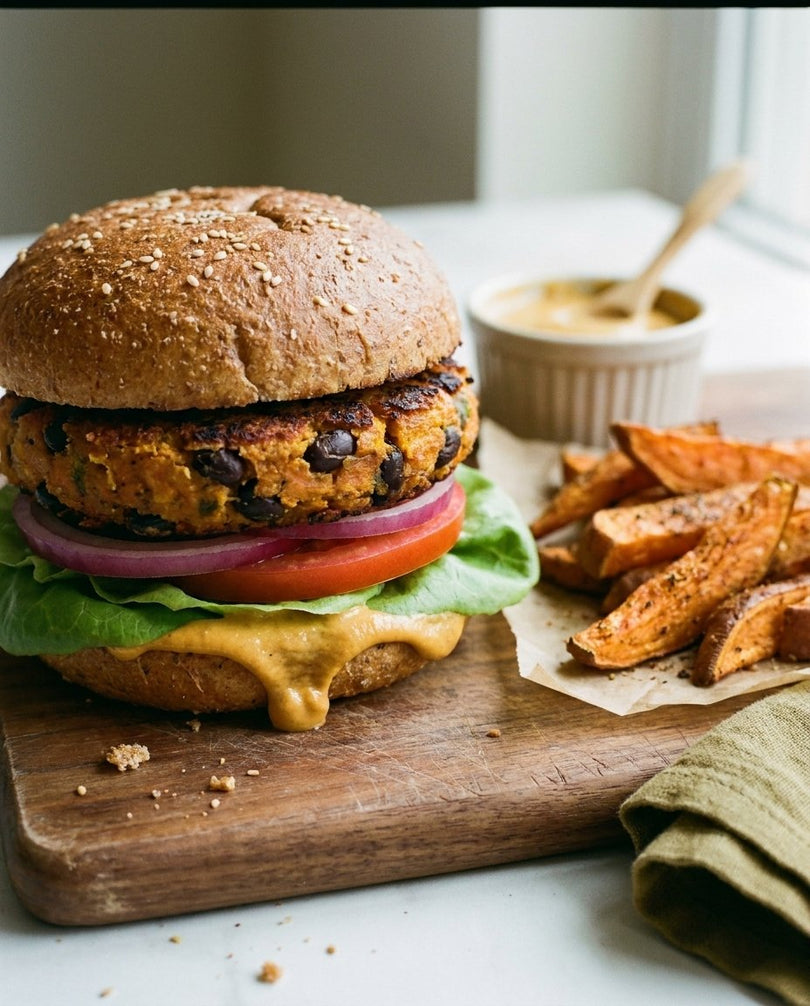
Legumes carry all three — lentils, chickpeas, black beans, split peas. Pumpkin seeds and sesame are dense in them. So are sunflower seeds, walnuts, almonds, quinoa, and the sprouts and leafy greens that make up the base of the diet. There is nothing exotic on that list, and nothing that needs ordering. It is a bean, a seed, a green thing, eaten often enough to matter.
This is where we would put the effort first, and not only because it is cheaper. A woman whose plate has been thin for years is not short of one compound. She is short of the materials for everything her body is trying to build, and creatine is one line item on a long list. Plant protein supports muscle growth perfectly well when there is enough of it, and "enough" is the word that trips most people up. Most women arriving at this come in depleted after decades of a plate that was never built to rebuild anything. Maintenance and rebuilding are not the same quantity of food, and the second one asks more.
If the plate is the thing that has been missing, start there. Replace Before You Eliminate is still the gentlest way in, and a day on the diet will tell you more about what to expect than any supplement label.
If you do decide to try it
Almost every study on this subject used creatine monohydrate, which is why it is the form with something behind it. The International Society of Sports Nutrition put ordinary maintenance at three to five grams a day, noted that the week of large doses some labels call loading is not required, and reported that long-term use has been well tolerated in healthy people (JISSN, 2017).
The postmenopausal trials used five grams or more. Below that, nothing happened.
The first question we hear from women who eat the way we do is whether it comes from an animal. It doesn't. The creatine monohydrate sold as a supplement is manufactured from two simple compounds, sarcosine and cyanamide, rather than extracted from meat (U.S. Patent 5,719,319). It is worth reading the label for anything added alongside it, the same as with any jar.
And then there is the part nobody has studied: whether creatine behaves the same way in a woman eating a fully plant-based diet through menopause. The trials in postmenopausal women did not sort anyone by what they ate. The research on lower stores in plant-based eaters was done largely in athletes. Putting those two findings together to assume an answer would be a guess. It has not been studied.
What is reasonable to say is that a woman already eating this way is not at risk of taking something her body has plenty of. If anything she has more room than most.
If you want a second set of eyes on it, a nutritionally minded health care professional is the right person to ask — somebody who will look at your whole plate before they look at your jar.
The frame we keep coming back to
There is a line of thinking in the wellness aisle that pictures the body as a machine with missing parts, and every bottle as a part. We have never found that to be true. Your liver and kidneys have been quietly manufacturing this compound every day of your life without being asked, out of material that came off a plant, in a system nobody had to design because it was designed already.
Creatine might be a useful tool for a woman who has started lifting something heavier than she has lifted in years and wants that work to count for a little more. It is a tool. The plate is the foundation, the movement is the stimulus, and the body does the building — the way it was set up to from the beginning.
If you are tired in a way that food and rest have not touched, that is a different question with a different answer, and we have written about why that happens and about the particular frustration of normal lab results.
Questions We Hear Most Often
Q: Is creatine safe for women over 50?
A: In healthy people, long-term use at ordinary amounts has been well tolerated, according to the International Society of Sports Nutrition's 2017 position stand. The trials in postmenopausal women used five grams a day or more alongside resistance training. If you have a kidney concern or take medication, talk it over with a nutritionally minded health care professional first.
Q: Is creatine vegan?
A: Supplemental creatine monohydrate is manufactured from two simple compounds, sarcosine and cyanamide, rather than extracted from meat. Your own body also makes about a gram a day from glycine and arginine, which come from plant foods like lentils, pumpkin seeds and quinoa. Check the label for anything added alongside it.
Q: Do I need creatine if I eat a plant-based diet?
A: Not to get through an ordinary day — your body makes what it needs. Plant-based eaters do carry lower stores, and that matters most when muscle is asked for something hard and brief. Food comes first; creatine is a tool for a woman who is already doing resistance training and wants that work to count for a little more.
Q: Will creatine help my bones after menopause?
A: The research so far says no. A 2026 review of seven trials in postmenopausal women found gains in lean mass and leg strength with creatine plus resistance training, but no change in bone density.
Q: How much creatine did the studies use?
A: The postmenopausal trials that showed results used at least five grams a day. Smaller amounts showed nothing. The International Society of Sports Nutrition notes that the high-dose "loading" week some labels recommend is not required.
You Might Also Like
- Debunking Myths: Plant Protein Supports Muscle Growth Effectively
- Whole-Food Supplements: What to Look For, and How the Popular Ones Compare
- Replace Before You Eliminate: What You Actually Get to Keep
- Why You're So Tired All the Time (And Why It's Probably Not Your Thyroid)
- Why You Feel Off When Your Labs Come Back Normal
- What a Day on the Hallelujah Diet Actually Looks Like
Sources
- Candow D, et al. Creatine Supplementation Beyond Athletics: Benefits of Different Types of Creatine for Women, Vegans, and Clinical Populations — A Narrative Review. Nutrients, 2025. https://www.mdpi.com/2072-6643/17/1/95
- Creatine monohydrate for lean mass, strength, and bone density in postmenopausal women: a systematic review and meta-analysis. Journal of the International Society of Sports Nutrition, 2026. https://ro.ecu.edu.au/ecuworks2022-2026/8225/
- U.S. Patent 5,719,319 — Process for the preparation of a creatine or creatine monohydrate (sarcosinate + cyanamide). https://patents.google.com/patent/US5719319
- Kreider RB, et al. International Society of Sports Nutrition position stand: safety and efficacy of creatine supplementation in exercise, sport, and medicine. Journal of the International Society of Sports Nutrition, 2017. https://jissn.biomedcentral.com/articles/10.1186/s12970-017-0173-z
We offer these teachings freely to support clarity, stewardship, and responsible care. If this article was helpful, you may explore additional resources here:
- MyHDiet.com — plant-based nutrition, enzymes, detox foundations
- WipeOutToxins.com — toxin-free living and prevention
- CleanseYourBlood.com — circulation and blood-flow support
- HealthRetreat.com — Hallelujah Diet Health Retreat
- AMPMForHealth.com — everyday wellness rhythms and curated tools
Thank you for being part of a community committed to thoughtful, responsible care.
Last reviewed 5 October 2026.