
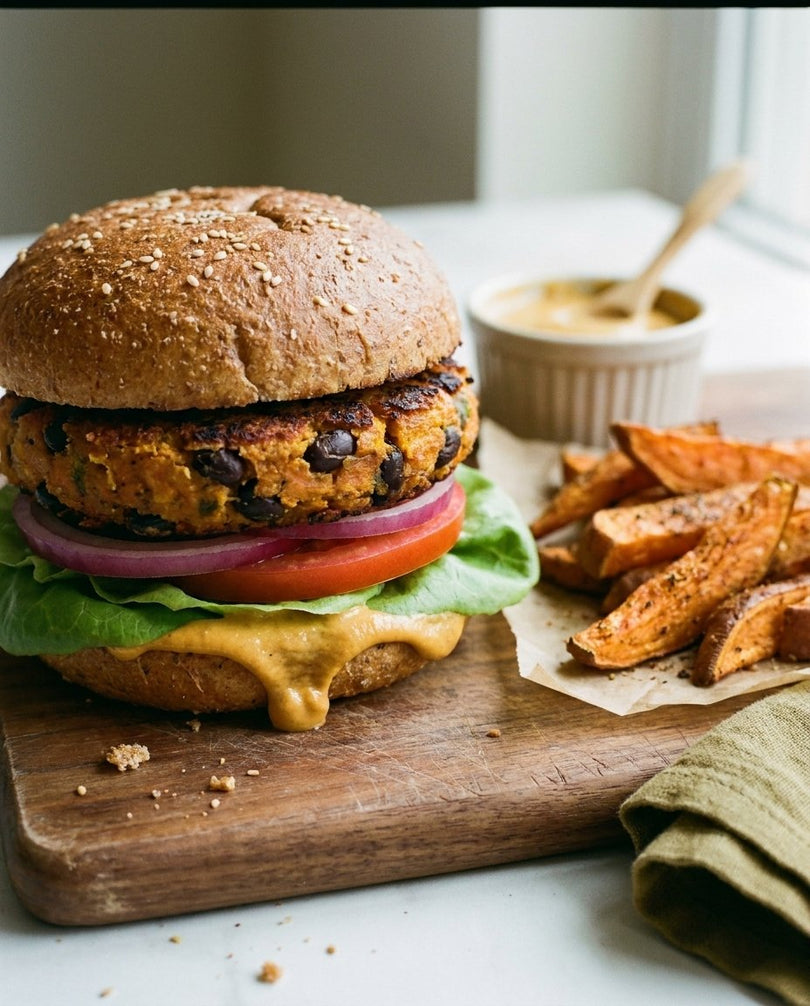



Almost every article like this one shows you a single perfect day and leaves it there. A photograph of breakfast, a photograph of lunch, something colorful in a bowl at six in the evening, and an unspoken promise that this is what every day looks like from here on.
It isn't dishonest, exactly. It's just frozen. It shows you one moment in a process and never mentions that the process moves.
We've been at this for more than thirty years, and the most useful thing we know about a day on this diet is that it doesn't stay the same. What it looks like in your first month and what it looks like in your tenth year are different in ways nobody tells you about — and the direction it moves in is the part worth knowing before you start.
So this is both. Here's the beginning. Here's where it tends to go.
The beginning: more food than you expect
The first thing that surprises people is the volume.
Most eating changes start with subtraction, and subtraction is why most of them end. You take away the bread, the sugar, the coffee, and you spend the day noticing the shape of what's missing. That's not a plan. That's a countdown.
We start the other way round, and we've named it because it matters more than any other single thing we teach: "Replace Before You Eliminate."
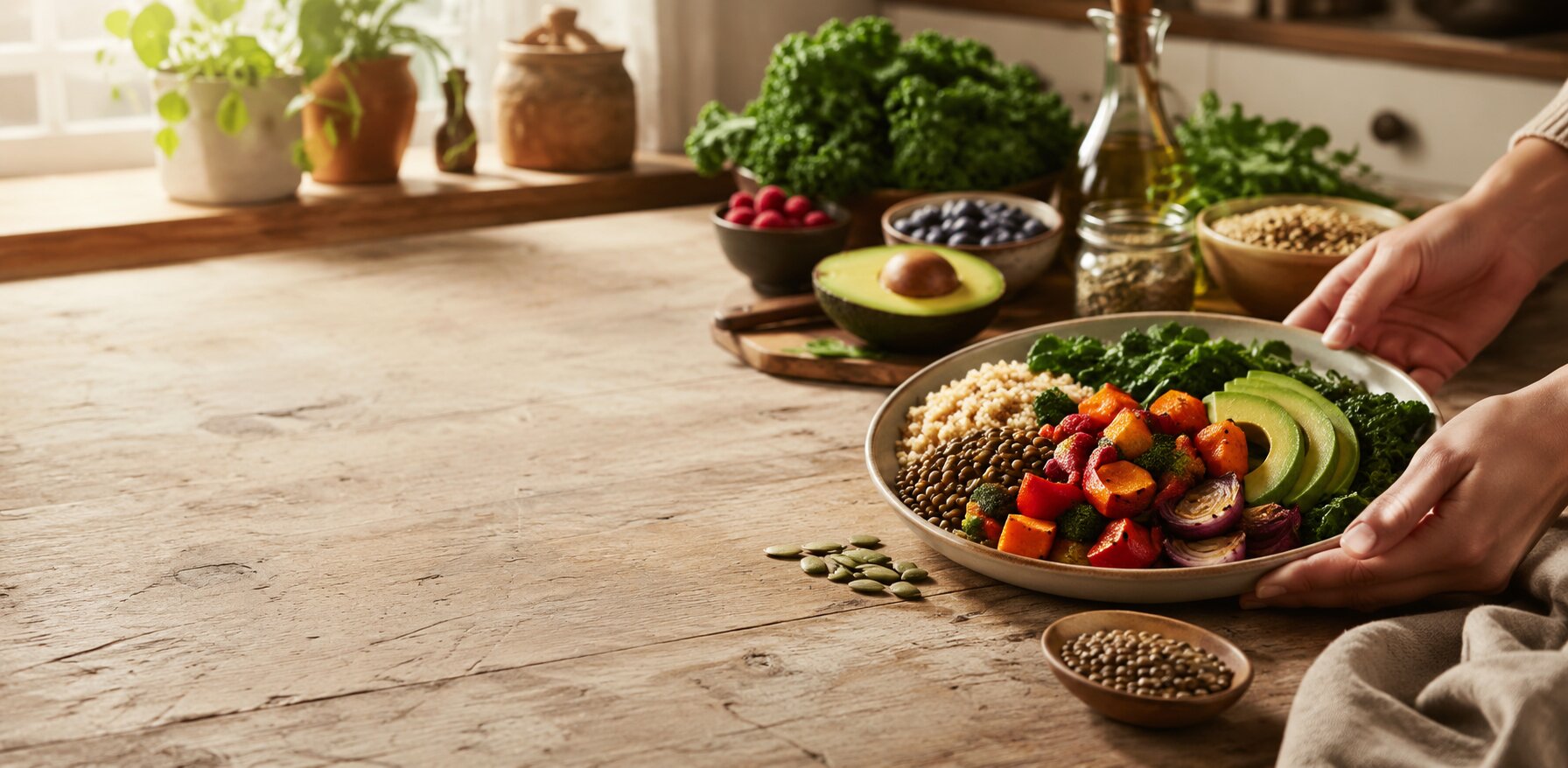
In practice, day one looks like this. You add a large raw salad. You add a green juice or a green drink in the morning, before anything else. You add fruit, nuts, seeds, more vegetables than feel reasonable. You don't take anything away yet.
The plate is fuller than it was. That's the point. A person who is genuinely full is not fighting anything, and a person who is fighting something is on a clock.
What actually happens over the following weeks is that the old food starts losing its grip on its own. Not because you resisted it — because there was less and less room, and because a body that's finally getting what it was asking for stops asking so loudly. Elimination becomes a result rather than a task.
Most people don't believe this until it happens to them. We've stopped trying to argue anyone into it and just ask them to try the adding part first.
That's one half of the principle. The other half is the one people find more reassuring, and it has an article of its own: you take the foods you'd genuinely miss and you rebuild them out of better material. Replace Before You Eliminate has the swaps sorted by what you'd actually miss rather than by food group — which is how the missing actually happens. We didn't give up ice cream. We make it.
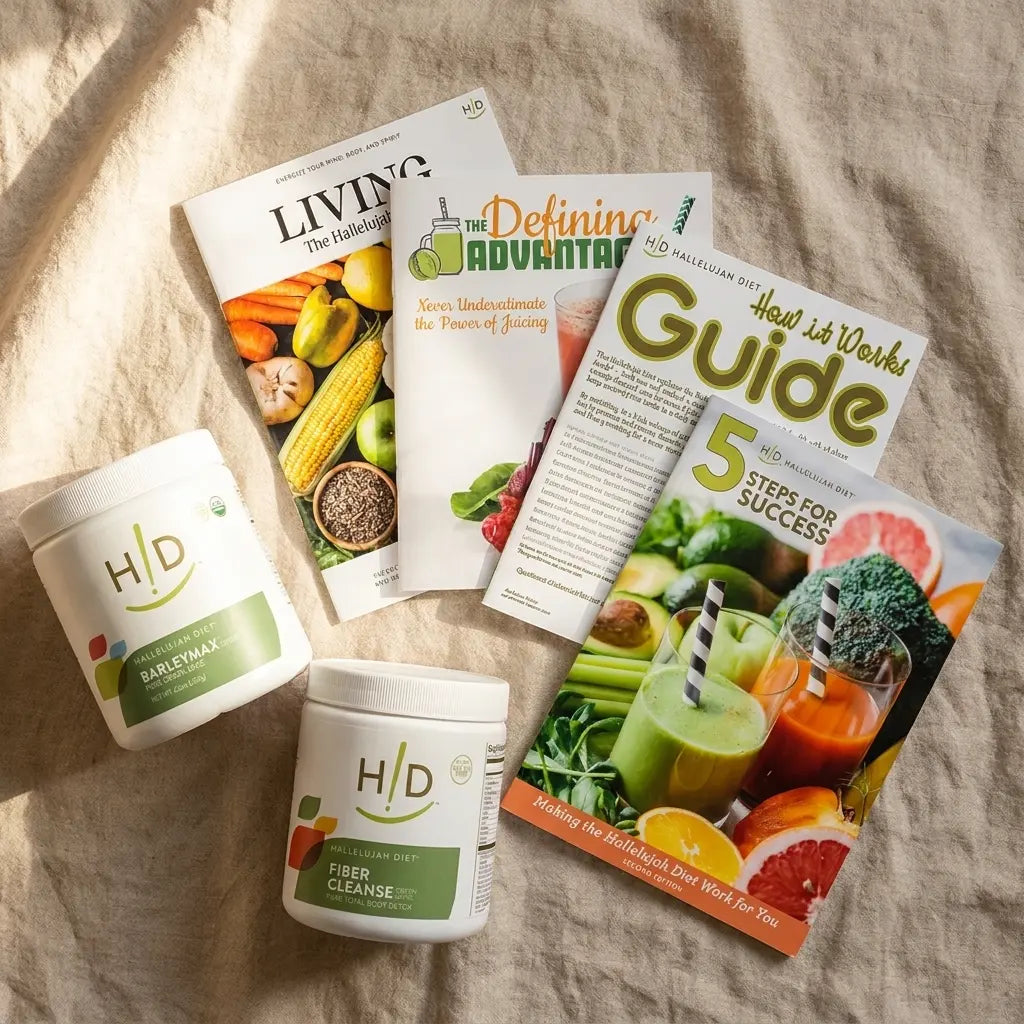
If you'd like to see what that looks like laid out with actual recipes, we've put a version of it on one page — a guide to a day on the Hallelujah Diet, with the morning habit, the meals, and where to begin.

The middle: it stops taking so long
The second phase is the one people quit in, and it's almost never about willpower. It's about Wednesday.
Eating this way takes real time if you do it meal by meal. Wash, chop, assemble, three times a day, while tired. Nobody sustains that, and nobody should have to.
What the people who last figure out — usually by accident, around month two or three — is that the work moves. It stops being a daily task and becomes a weekly one.
That's the whole idea behind the salad box: an hour on Sunday, everything washed and chopped and waiting in its own container, so that dinner is assembly rather than cooking. Once that's in place, a salad takes five minutes, and so does a wrap, and so does most of a soup. The jar version does the same job away from home — a desk, a car, a week at the grandchildren's.
A blended salad is a legitimate meal. So is a plate of steamed vegetables next to a raw one. So is soup you pulled out of the freezer because you made too much three weeks ago and had the sense to freeze half.
None of it is impressive. All of it is repeatable, which is the only quality that matters over ten years.

Later: the plate gets simpler
Here's the part that isn't on anybody's website.
The longer people eat this way, the less elaborate their food becomes. Not worse — simpler. The recipes that got them started stop being necessary. A salad, something green in the morning, whatever vegetables are in the house. Repeated, without much variation, without much thought.
And alongside that, something else changes that people rarely expect: the wanting quiets down.
Not through discipline. Through arithmetic. A body that is genuinely getting what it needs stops sending the signal that it isn't. Hunger becomes information rather than an emergency. People notice they've gone longer than they meant to without eating and weren't uncomfortable. They notice that food has stopped being the thing they think about between the things they're doing.
That's the change we'd point to over any number on a scale, and it's the one nobody photographs, because there's nothing to photograph. It looks like an ordinary afternoon in which nobody thought about lunch.
Don't chase the quiet
We want to be careful here, because this is exactly the kind of thing that gets turned into a target, and it must not be.
Eating less is not the goal and it is not the instruction. The settling we're describing is something that happens to people when nutrition is met — it is not something to aim at, hurry, or measure. If you eat when you're hungry and you're hungry often, nothing is wrong with you. Some people's appetite quiets in a year and some never particularly does, and both of those are fine.
If you have a history of dieting, of counting, of rules — and a great many women we talk to do — then please read this section twice. The whole point of what we teach is to stop negotiating with food. An eating pattern that leaves you hungry, or that turns "how little did I need today" into a score, is the old thing wearing new clothes. We'd rather you ate a larger salad.
Abundance first. Always. That was the point of the beginning and it's still the point at year thirty.

And what about Saturday?
Nobody eats this way at every meal for thirty years, and we have never once asked anyone to.
Early on, the meal out is doing real work. Deprivation is what ends most eating changes, and it ends them quietly — not in a dramatic collapse but in a slow accumulation of feeling shut out. A dinner you look forward to takes the pressure off the other six days. It isn't a lapse in the plan. It's part of why the plan lasts.
We see two patterns, and both of them work.
The first is a rhythm. The box covers Sunday through Friday, and Saturday is dinner out. Nothing is being resisted the rest of the week because there's something on the calendar.
The second is about the house. Some people eat whatever they like when they're out and simply don't bring it home. That one is worth pausing on, because it's the more powerful of the two: the decision that matters gets made at the grocery store, not at the restaurant. A kitchen with nothing in it you're arguing with is worth more than any amount of resolve at seven in the evening. Change the environment and most of the willpower question disappears.
And here is the part people don't expect. Over time, the wanting on Saturday quiets down the same way it does everywhere else. Not because anyone decided to be stricter — because taste actually moves. People find themselves ordering differently, not out of discipline but out of preference, and noticing afterward that they'd have chosen the same thing anyway.
We don't call this cheating, and we'd rather you didn't either. There is nothing here to cheat on. We haven't given you a set of rules to break — we've suggested you add some food, and a dinner out on Saturday doesn't undo a week of it. The word carries a judgment that has no place in this, and in our experience the people who use it are the ones who quit.
What doesn't change
For all the drift, a few things stay put from the first week to the thousandth.
Something living, early. Green juice, a green drink, a large raw salad before anything cooked. Ahead of the day rather than squeezed into it. This is the single habit that survives when everything else about a person's routine changes.
Raw as the majority. Roughly eighty-five percent raw and living food, with cooked plant food playing the supporting role. That proportion has held for thirty years because it's both effective and livable, which is a rarer combination than it sounds.
Water. Ordinary, unglamorous, and the first thing to slip when life gets busy.
Sleep. Most of the repair happens in the dark, and no amount of good food outruns a short night.
And the reason underneath all of it, which hasn't changed since the first chapter of the first book:
"And God said, Behold, I have given you every herb bearing seed, which is upon the face of all the earth, and every tree, in the which is the fruit of a tree yielding seed; to you it shall be for meat." — Genesis 1:29
That's a provision statement. The food came first, and it came on purpose, for a body built to run on it. Everything we teach is an attempt to arrange an ordinary week so a person actually eats it. If you'd like the fuller picture, we've walked through what Scripture says about food passage by passage.
So what does a day look like?
Honestly? It depends entirely on where you are in it.
In month one it looks like more food than you're used to, most of it raw, arriving on purpose. It takes effort and it should — you're learning a new set of habits, and new habits cost something.
In month six it looks like an hour on Sunday and five minutes at six in the evening. The effort moved. That's the whole trick.
In year ten it looks like very little at all. Simple, repetitive, unremarkable food that somebody stopped needing to think about — and an afternoon that goes by without the question of what to eat coming up once.
None of those three days would make a good photograph. All three are what actually happens.
Questions We Hear Most Often
Q: What does a typical day on the Hallelujah Diet look like? A: A green drink or juice first thing before anything else, a large raw salad as a main meal, more raw food than cooked across the day — roughly eighty-five percent raw with cooked plant food in a supporting role — and plenty of water. What varies is the effort involved. Early on it takes real time. Once a week's prep is done in one session, most meals take five minutes.
Q: Do I have to eat one hundred percent raw? A: No, and we don't teach that. The proportion we teach is a majority-raw plate with cooked plant food supporting it, because that's what people can live with for decades rather than for three weeks. Consistency at eighty-five percent beats perfection that doesn't last.
Q: How much time does this take each day? A: Less than people expect, once the prep moves to a weekly session. An hour on a Sunday covers most of the week's chopping, and meals become assembly. Meal by meal, without that system, it's genuinely time-consuming — which is the main reason people give up, and it's a solvable problem rather than a character one.
Q: What do you eat for breakfast? A: Something living, before anything cooked. A green juice, a green drink, a smoothie, or fruit. The specific form matters much less than the order — ahead of the day rather than after it has started.
Q: Will I be hungry? A: Not if you're doing it right. The whole approach starts by adding rather than subtracting, and the plate is usually fuller than what it replaced. If you're hungry, eat — and eat more raw food rather than less. Hunger is a sign the arithmetic isn't working yet, not a sign you're succeeding.
Q: I've heard people eat less over time. Should I be aiming for that? A: No. It's something that happens on its own to some people once nutrition is genuinely met, and it isn't a target, a milestone, or a measure of how well you're doing. Plenty of people never experience it and are perfectly healthy. Aiming at it turns a good way of eating into another set of rules, which is exactly what we're trying to get you out of.
Q: What about eating out, or a meal I didn't plan? A: Have it. Especially early on, when the feeling of being shut out is the most likely reason a person stops. Many people settle into a rhythm — the salad box covers the week, Saturday is dinner out — and others eat whatever they like when they're out but don't bring it home. That second one is the stronger habit, because the decision that matters is made at the grocery store rather than at the restaurant. We don't call it cheating and we'd rather you didn't; there's nothing here to cheat on.
Q: Do I have to give up the foods I love? A: Far less than people assume. Most of what people are afraid of handing over can be rebuilt out of better material — ice cream, cheese, butter, ketchup, bread — and most of those are easier to make than they sound. That's the other half of Replace Before You Eliminate, and we've written the whole of it out in what you actually get to keep, sorted by the craving rather than by food group.
Q: Does it get boring? A: The food gets simpler over time, which some people find restful and others find dull. If it's tipping toward dull, that's a shopping habit rather than a limit of the diet — change the dressing, change the green, put it in a wrap, turn it into soup.
Q: What about supplements? A: They're tools, not the foundation. Soil isn't what it was, and most people start with ground to make up, so a few well-chosen supports have a real place. But they work alongside living food, never in place of it. If you're comparing them, we've written about what to look for in a whole-food supplement.
Q: How long before I notice anything? A: Many people notice steadier energy and easier digestion within the first two or three weeks. Deeper changes take longer, and some of the useful ones are invisible for a while. Ninety days is a fair point at which to judge it.
Q: I'm tired all the time. Is that what this fixes? A: Tiredness has more than one cause and food is only one of them, though it's the one most often overlooked. We've written separately about why you're so tired all the time, including the causes that have nothing to do with your plate.
Q: Where should I actually start? A: With one addition, not one subtraction. A green drink in the morning, or a large raw salad before your main meal. Then let it crowd the rest out on its own schedule. Nobody sustains a way of eating they experience as a loss.
Seven Steps, One at a Time
If you'd like the beginning written out properly rather than described, we've put it together as a free guide — God's Original Diet, seven steps, with the reasoning under each one.
It's built to be read a step at a time rather than all at once, which is also how we'd suggest doing it. You may already be living two or three of them. Start wherever you actually are.

Where to Start
You don't need the whole thing on the first day. You need one thing added, repeated until it's ordinary.
If a list of what's worth adding would help, The Yes List is twenty-five foods with a note on what each one is doing there.
And if you'd like to see a day laid out properly — the morning habit, the meals, the recipes, and the three sensible ways to begin — that's all on one page.
You Might Also Like
- Replace Before You Eliminate — the other half of the principle. What you get to keep, and how to make it.
- The Salad Box — an hour on Sunday, and the good thing becomes the easy thing at six in the evening.
- Salad in a Jar — the same idea, built to travel. The layering order and how long one actually keeps.
- What the Bible Actually Says About Food — the passages in order, with a short note on each.
- Why You're So Tired All the Time — the causes that have nothing to do with your plate.
We offer these teachings freely to support clarity, stewardship, and responsible care. If this article was helpful, you may explore additional resources here:
- MyHDiet.com — plant-based nutrition, enzymes, detox foundations
- WipeOutToxins.com — toxin-free living and prevention
- CleanseYourBlood.com — circulation and blood-flow support
- AMPMForHealth.com — daily support essentials
- HealthRetreat.com — Hallelujah Diet Health Retreats
Thank you for being part of a community committed to thoughtful, responsible care.