




By Paul and Ann Malkmus
It isn't a silly question. It's one of the oldest ones there is.
What people are usually hoping for is a clean answer in one direction or the other. Either a list — here is what's permitted, here is what isn't, follow it and you've done right. Or a dismissal — that was all long ago, none of it applies now, eat what you like.
Scripture doesn't hand us either one. It says considerably more about food than most people expect, and it says it far less tidily than either side of the argument would like.
But there is a shape to it. And the shape is worth more than any single verse pulled out on its own.
The Big Idea
Food shows up at nearly every hinge point in Scripture — the garden, the flood, the law, the wilderness, the table Jesus keeps sitting down at, the arguments in the early church. It's never treated as trivial. It's also never turned into the measure of a person.
Reading the whole arc, rather than mining it for a rulebook, is what makes the difference.

It Starts in a Garden
The first thing God says about food, He says before anything has gone wrong.
"Behold, I have given you every herb bearing seed, which is upon the face of all the earth, and every tree, in the which is the fruit of a tree yielding seed; to you it shall be for meat." (Genesis 1:29)
Read it as a nutrition instruction and it's remarkably specific. Plants bearing seed. Fruit bearing seed. Things that reproduce themselves, whole, close to how they grew.
Notice what it isn't. It isn't a prohibition. Nothing is forbidden in that verse — it's a description of provision, of where the nourishment was put. The first boundary around food doesn't arrive until the next chapter, and it concerns one tree.
That ordering matters. Provision came first. Restriction came second, and it was narrow.

Then Things Change
By Genesis 9, after the flood, the terms are different. Meat is permitted, with a restriction about blood attached to it. The world has changed, and Scripture doesn't pretend otherwise.
Anyone who tells you the Bible teaches one unbroken diet from cover to cover is skipping this chapter. It's there, it's plain, and it belongs in the picture.
It's also worth setting the lifespans in Genesis 5 alongside what comes after, and simply noticing. People have drawn several different conclusions from that comparison. We'd rather you look at it yourself than take ours.
The Law Gets Detailed
Leviticus 11 and Deuteronomy 14 lay out clean and unclean animals in real detail. Fat and blood are set apart as not to be eaten. There are instructions about preparation, about what touches what.
And in Daniel 1, a young man asks for ten days of vegetables and water rather than the king's provision — and the text is happy to report how he looked at the end of it.
Whole traditions have been built on these chapters, and whole traditions have set them aside. What's harder to argue is that they show a God who cares about the ordinary business of what goes on a plate. That care is consistent even where the specifics shift.

Jesus and the Table
Here's what surprises people who expect the Gospels to tighten the rules: Jesus is constantly eating.
He eats with the wrong people, often enough that it becomes a formal complaint against Him. He feeds crowds with bread and fish. After the resurrection, He eats broiled fish in front of His disciples — a detail that has to sit alongside whatever conclusions anyone reaches elsewhere.
And in Mark 7, He says the thing that has been argued over ever since: what goes into a person doesn't defile him; what comes out of the heart does.
That passage deserves to be read slowly, in context, rather than deployed as a trump card by either side. But its direction is unmistakable. The center of gravity moves inward.

The Letters Get Uncomfortable
The early church argued about food. Quite a lot.
Peter has a vision of a sheet lowered with all manner of creatures on it, and is told to eat. Read on to what Peter says it meant — verses 28 and 34 — and you'll find he applies it to people, not menus.
Then there's Romans 14, which is the passage we'd point to before any other in this whole conversation. One believer eats anything. Another eats only vegetables. And Paul's instruction is not to settle who's correct. It's this: don't despise each other over it.
First Timothy 4 goes further, and it should give pause to anyone drawn toward strictness — it names the forbidding of foods as a mark of teaching gone wrong. Colossians 2 says don't let anyone judge you regarding what you eat, then adds a caution about harsh treatment of the body.
Read together, these are not the letters of a movement building a food code. They're the letters of a movement trying to stop one from forming.

So What Does It Mean for Dinner?
Here is where we'll tell you what we think, and you should weigh it as exactly that.
We don't believe Scripture hands us a menu. We think the search for one usually ends badly — in scrupulosity, in judging a brother, in the very thing Romans 14 was written to prevent.
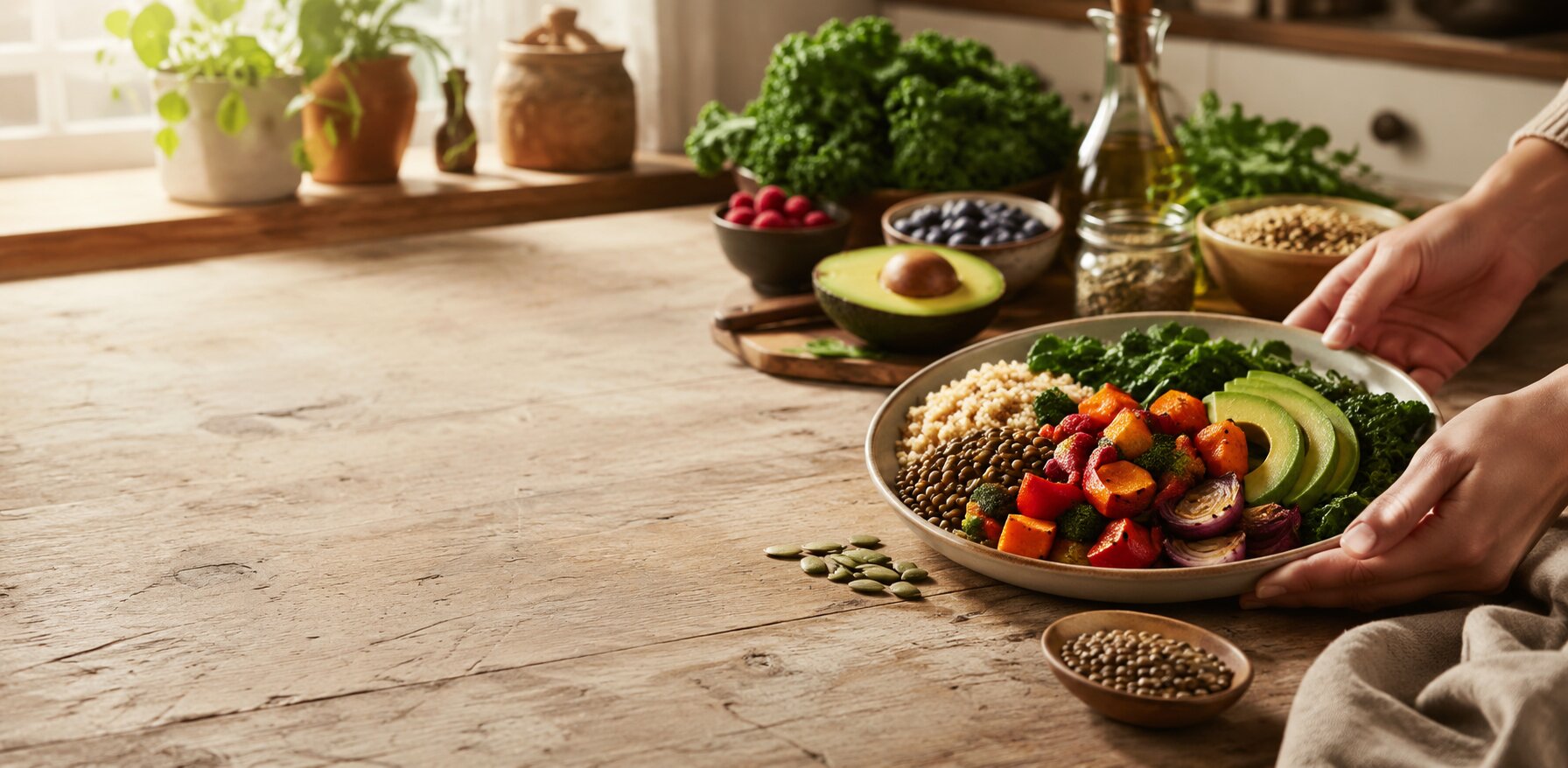
What we do believe is that Genesis 1:29 describes where nourishment was put. Not as a boundary to police, but as a starting point worth returning to. When we've watched people move their eating back toward it — living plants, seeds intact, close to how they grew — we've watched their energy, their digestion, and their sense of wellbeing follow. Thirty years of that isn't proof of a doctrine. It's just what we've seen, over and over.
Some simple ways to begin, if the arc of this rings true:
- Start with what the garden offered. Green things, whole grains, beans, seeds, fruit. Add them before you take anything away.
- Eat food that still looks like it grew. The further something is from its original form, the less of the original nourishment tends to survive.
- Receive it with thanks rather than anxiety. Scripture is not suspicious of food. Psalm 104 describes provision with obvious pleasure.
-
Hold it loosely with other people. However convinced you become, Romans 14 still applies at your own table.
The Hallelujah Diet Perspective
We've built a life and a ministry around one verse in the first chapter of Genesis. So we understand the temptation to make that verse into a test, and we want to say plainly that it isn't one.
Our conviction is that God's original provision is still the best foundation available to a human body. We hold it firmly. We've watched it help thousands of people. And it is not the measure of anyone's faith, and never will be.
The most striking thing about food in Scripture isn't the lists. It's how consistently God involves Himself in something as ordinary as a meal — and how consistently He refuses to let it become the thing that separates His people from one another.
That's a hard balance to hold. It's also, we think, the whole instruction.
Questions We Hear Most Often
Does the Bible say Christians should be vegetarian?
No, not directly. Genesis 1:29 describes a plant-based provision before the flood, and Genesis 9 permits meat afterward. Passages like Romans 14 and 1 Timothy 4 explicitly warn against making dietary rules a test of faith. Many believers — ourselves included — choose a plant-based way of eating because of what we understand about God's original design and what we've seen it do for people's health, but Scripture presents that as a freedom rather than a command.
What is Genesis 1:29, and why do people build diets around it?
It's the verse where God describes the food given to humanity at creation: every seed-bearing plant and every tree with seed-bearing fruit. People build around it because it's the only place Scripture describes an eating pattern chosen by God before anything had gone wrong in the world. It's a starting point, not a restriction — nothing is forbidden in that verse.
Do the clean and unclean food laws still apply?
Christians have disagreed about this for two thousand years and still do. Leviticus 11 and Deuteronomy 14 lay out the distinctions in detail. Mark 7, Acts 10, and Romans 14 are the passages most often cited as changing how they apply under the new covenant. Our encouragement is to read all of them yourself rather than accept a summary from either direction.
What is the Daniel Fast?
It comes from Daniel 1, where Daniel asks for vegetables and water instead of the king's provision for ten days, and from Daniel 10, which describes a longer period without rich food. It's typically practiced today as 21 days of plant foods, no added sugars, and no processed items. It's the one widely practiced diet framework that's both plant-based and explicitly scriptural.
Isn't focusing on food legalistic?
It can become that, and the New Testament warns about it directly — which is why we try to hold our own convictions firmly and other people's loosely. There's a real difference between stewarding a body well and using food to measure yourself or anyone else. If a way of eating is producing anxiety or judgment, something has gone wrong regardless of how healthy the food is.
Where should I start if I want to study this myself?
Read the passages in order rather than topically — the garden, the flood, the law, the Gospels, the letters. The arc tells you more than any single verse. We've put the passages together with a short note on each in a free reading guide below; it works for personal study or a small group.
Where should I start if I want to study this myself?
Read the passages in order rather than topically — the garden, the flood, the law, the Gospels, the letters. The arc tells you more than any single verse. We've put the passages together with a short note on each in a free reading guide below; it works for personal study or a small group.
Where to Start
If you'd like to look at this for yourself rather than take our word for it, we've put the passages together in order — the garden, the flood, the law, the Gospels, the letters — with a short note on each.
It's called Food in Scripture, it's free, and it's built to work either for personal study or for a small group. There's enough in it for six evenings.

You may also find these helpful:
- Genesis 1:29 diet prevents and corrects diabetes
- A beginner's guide to understanding the Jesus Diet
- What is Essene bread
We offer these teachings freely to support clarity, stewardship, and responsible care. If this article was helpful, you may explore additional resources here:
- MyHDiet.com — plant-based nutrition, enzymes, detox foundations
- WipeOutToxins.com — toxin-free living and prevention
- CleanseYourBlood.com — circulation and blood-flow support
- AMPMForHealth.com — stewarded health for the rhythm of real life
- HealthRetreat.com — Hallelujah Health Retreats
Thank you for being part of a community committed to thoughtful, responsible healing.



1 comment
Central Virginian
Detailed and balanced Bible study. Very helpful
Detailed and balanced Bible study. Very helpful