



By Paul and Ann Malkmus
The casseroles come for about two weeks.
Then they stop. The last dish gets washed and carried back to whoever brought it, the cards slow down, and the house goes quiet at six o'clock in a way it never did before. There is still food in the refrigerator. You stand in front of it with the door open, close it again, make tea, and call that supper.
If that is where you are, nothing here is going to ask you to cook.
What grief does at the kitchen table
People have studied this, and what they found is gentler than you would guess.
In a 1993 study in the Journal of Gerontology, Christine Rosenbloom and Frank Whittington interviewed fifty recently widowed people over the age of sixty alongside fifty married people of similar age, and had all of them keep three days of food records. Their conclusion was that widowhood changed the social environment around eating, and that the change showed up both in how people ate and in the nutrients they were getting.
A 2016 study in the Journals of Gerontology: Series B went after the why. Elisabeth Vesnaver and her colleagues sat down with fifteen widowed women between the ages of seventy-one and eighty-six, all living alone, some six months out and some fifteen years out. The women cooked far less than they once had and leaned on prepared food instead. Many of them said in one wording or another that cooking for one was not worth it.
The same interviews turned up something else. The pleasure these women took in food was still there. What had gone was the second chair.
Taste did not leave. Hunger did not leave. The reason to set a table left, and the cooking went with it.
What still goes down when a plate will not
The useful question this week is what nourishes you with the energy you actually have.
Soup. One pot, once, and you have five or six suppers. Lentils, carrots, celery, onion, a little garlic, whatever greens are in the drawer, and water. It reheats in four minutes and it asks nothing of you on the evenings you have nothing to give. A pot of soup on the stove is also the one thing that still makes a kitchen smell like somebody lives there.
Something blended. A banana, a handful of frozen berries, a scoop of frozen spinach or kale, a spoon of tahini or almond butter, a tablespoon of ground flaxseed, water. Thirty seconds, no chewing, no pan, nothing to wash but the pitcher. On the mornings when the thought of breakfast is too much, this is breakfast.
Fresh juice. Carrot, celery, cucumber, a little beet, a handful of greens. Juicing takes the fiber out so the nutrients reach the bloodstream quickly, which is exactly what you want when very little is going in. The whole foods and the fiber you eat the rest of the day carry waste and toxins out. The two jobs work together, and neither one replaces the other.
A glass of BarleyMax. Stirred into water, it takes less effort than making tea. Organic barley and alfalfa grass juice powder, dried at low temperature so the live enzymes survive. On a day when nothing else gets eaten, this is still something green reaching your cells. The soup and the juice and the greens are the foundation; this is a tool that sits alongside them. There are weeks when the tool is what gets used, and that is fine.
What to keep in the house so you do not have to decide
Grief eats decisions before it eats anything else. The trick is a kitchen that answers the question for you.
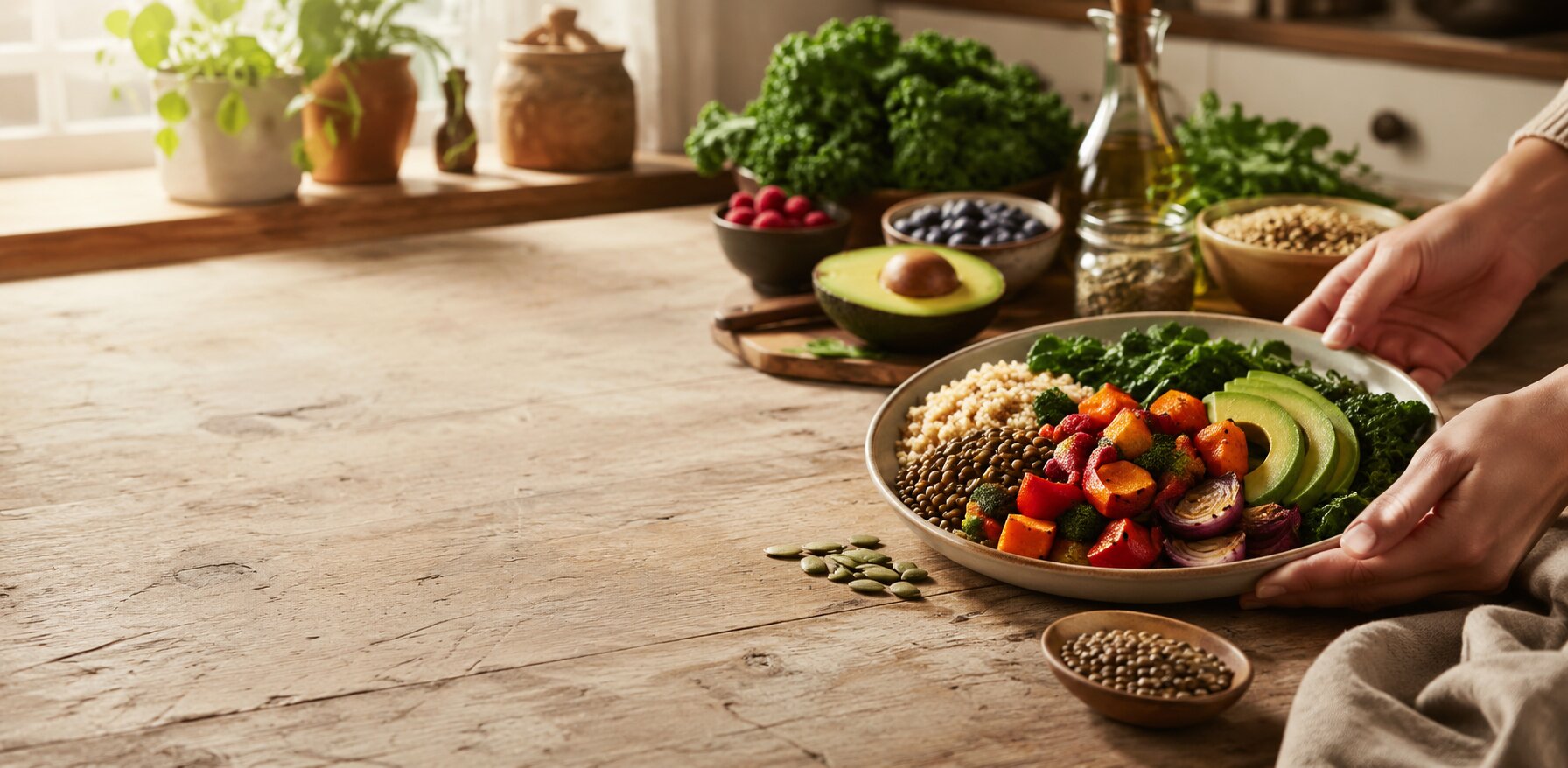
Frozen fruit and frozen greens, which keep for months. Bananas on the counter. Oats. Dried or canned lentils. Sweet potatoes, which need nothing but an oven and an hour. Jarred nut butter and tahini. Ground flaxseed in the freezer. Pumpkin seeds. Dates. A bag of carrots.
Nothing on that list needs a plan, and nothing on it goes bad while you are not looking. Salad in a Jar works on the same idea for the days you do have a little more in the tank — you make it once on Sunday and it feeds you on the evenings you cannot face a cutting board.
Toast keeps you upright. It does not rebuild you.
Toast and tea will get you through a Tuesday. It will not get you through a winter. Most of the women who write to us were running close to empty before the loss — years of caring for somebody, broken sleep, meals eaten standing up. Grief lands on a body that was already stretched thin, and then the body carries it, which is real work. It costs something.
If you only ever eat the minimum, you stay at the minimum, and six months from now you will wonder why you are still so tired. Rebuilding takes more than maintaining does.
That is why the easy things above are dense ones. Pumpkin seeds and dark greens and legumes bring magnesium, iron and zinc, which is what strain spends. Pair the iron with something high in vitamin C in the same meal — the lemon in the dressing, the pepper in the soup — and more of it lands. Flax, chia and walnuts carry the omega-3 fats. Legumes, seeds, sprouts, greens and quinoa carry the protein. B12 is the one thing a plant-based table does not supply, and the answer there is a supplement, checked every two or three years.
None of that requires a protocol. It only requires that whatever you reach for on the hard days be worth the swallow.
The second chair
If what those widowed women were missing was company, then the most useful thing we can offer you here is not a food at all.
Eat with one other person, once a week. A standing Thursday lunch with a neighbor. Sunday dinner at somebody's table instead of your own. The women's group, if your church has one, and if it does not, two friends and a pot of soup is a women's group. Ask somebody to come to you, which is easier than it sounds — most people have been looking for a way in since the funeral and do not know what to offer.
What surrounds us shapes us more than what we know. That is true of what we breathe and what we eat, and it turns out to be just as true of who is sitting across the table.
What the body is doing while you grieve
Your body heals a cut without being asked. It knits bone. It replaces its own lining week after week while you are thinking about something else entirely. That capacity does not switch off because you are sad.
What it needs is what it has always needed. "And God said, Behold, I have given you every herb bearing seed, which is upon the face of all the earth, and every tree, in the which is the fruit of a tree yielding seed; to you it shall be for meat" — Genesis 1:29. Food that grew. Nothing complicated, and nothing you have to earn.
And the other half of it, which Scripture does not make us guess at: "The LORD is nigh unto them that are of a broken heart; and saveth such as be of a contrite spirit" — Psalm 34:18. He is not waiting for you to pull yourself together before He comes near. He is already near.
If it has gone on a while
If weeks have turned into months, and you are losing weight you did not mean to lose, or you have stopped eating in any real sense, that is worth bringing to a nutritionally minded health care professional. A second set of eyes can see what is happening with your body faster than you can from inside it, and there is no failure in that.
And if your appetite comes back on a Tuesday and vanishes again on Wednesday, nothing has gone backward. Grief does not travel in a straight line, and neither does hunger. Start again with the soup.
You Might Also Like
- Why You're So Tired All the Time (And Why It's Probably Not Your Thyroid)
- Salad in a Jar
- Replace Before You Eliminate: What You Actually Get to Keep
- What a Day on the Hallelujah Diet Actually Looks Like
- What the Bible Actually Says About Food
We offer these teachings freely to support clarity, stewardship, and responsible care. If this article was helpful, you may explore additional resources here:
MyHDiet.com — plant-based nutrition, enzymes, detox foundations
WipeOutToxins.com — toxin-free living and prevention
CleanseYourBlood.com — circulation and blood-flow support
HealthRetreat.com — Hallelujah Diet Health Retreat
AMPMForHealth.com — everyday wellness rhythms and curated toolsThank you for being part of a community committed to thoughtful, responsible care.
Sources
- Rosenbloom, C. A., & Whittington, F. J. (1993). The effects of bereavement on eating behaviors and nutrient intakes in elderly widowed persons. Journal of Gerontology, 48(4), S223–S229. academic.oup.com
- Vesnaver, E., Keller, H. H., Sutherland, O., Maitland, S. B., & Locher, J. L. (2016). Alone at the table: Food behavior and the loss of commensality in widowhood. The Journals of Gerontology: Series B, 71(6), 1059–1069. academic.oup.com