


That little fear that existed before you got married? Now it’s your reality. You're happy in your relationship with your husband. He's great, but he’s not enough. You really want a baby. And it's not working. PCOS has stolen from you what every young married woman wants.
You're not broken. You can change your destiny. In this article, I'm going to explain the biology behind iodine and how the lack of it might be one of the reasons you are where you are.
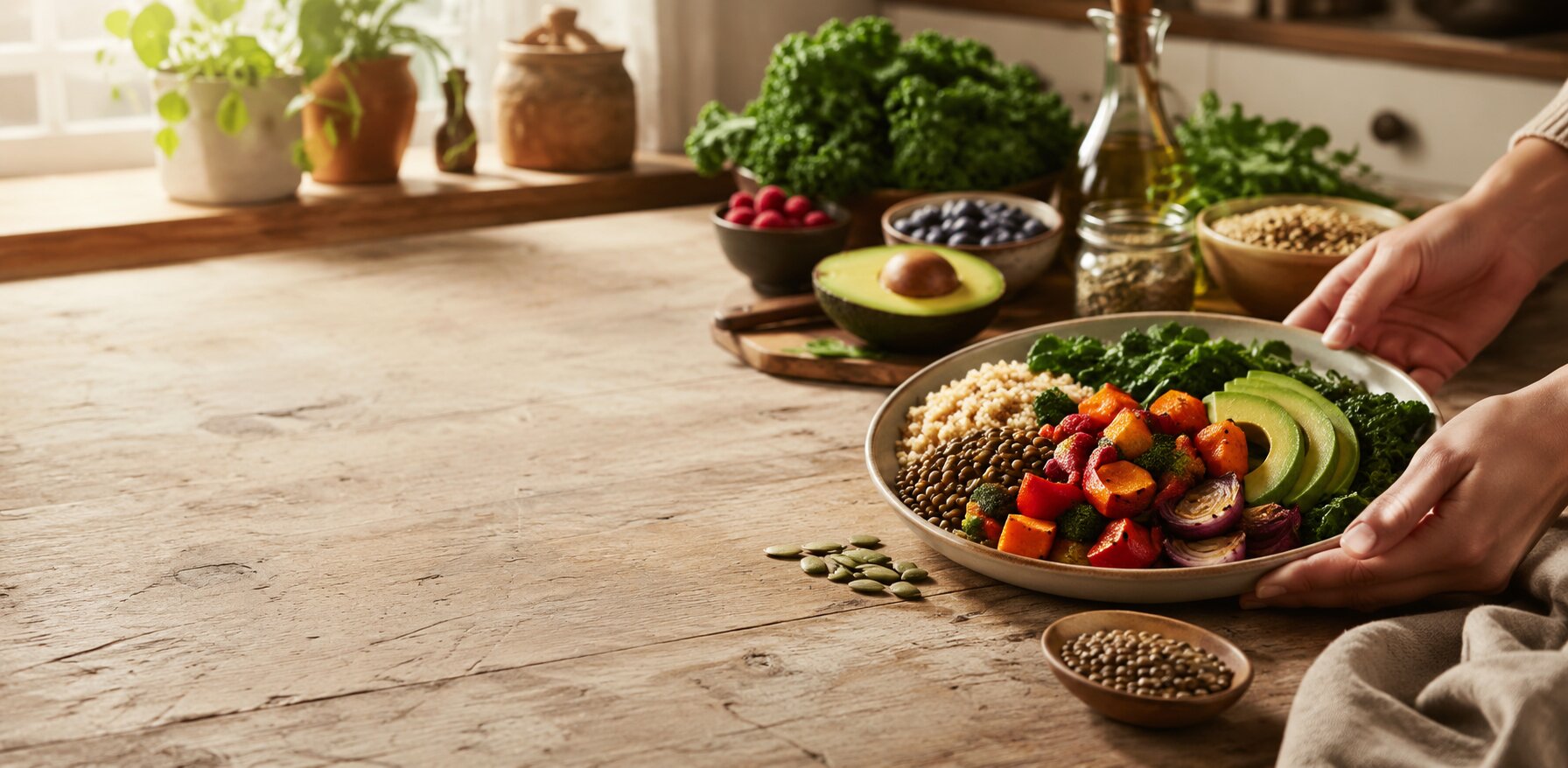
In the article on PCOS and diet, I covered the foods that help regulate blood sugar, reduce androgens, and support hormonal balance. We looked at what a plant-based dietary foundation can do to help women get through PCOS with fewer symptoms and more stability.
But there is one more piece worth adding to that picture. It is a mineral that most PCOS conversations completely leave out.
Iodine.
You probably associate iodine with thyroid function. That is where the conversation almost always stops. What most people do not know is that iodine is an essential micronutrient for ovarian function, specifically, and a shortage of it may be contributing to PCOS symptoms in ways that neither you nor your doctor has considered.
Your Ovaries Need Iodine, Too
Of all the tissues in the body that concentrate iodine, the ovaries rank among the highest, second only to the thyroid gland. The ovarian iodine content is not static, either. Research suggests it rises and falls with ovarian activity, peaking at the height of ovulation and declining when activity decreases. This cyclical pattern tells us that iodine is doing active work, not just passing through.
When iodine is in short supply, that work gets disrupted. The most direct consequence is impaired folliculogenesis. Follicles that do not get enough iodine to mature cannot proceed to ovulation. Instead, the immature follicle may fill with fluid and become a cyst within the ovary. Meanwhile, the continuous stimulation of these stalled follicles by luteinizing hormone (LH) can drive androgen overproduction. That is the classic PCOS pattern: cysts, elevated androgens, anovulatory cycles. And iodine deficiency can be one of the root causes. Is this making sense now?
Tracy Tranchitella, ND, summarized the mechanism at ZRT Laboratory: iodine deficiency negatively impacts folliculogenesis and the maturation of the ovarian follicle. If a follicle does not mature, ovulation cannot occur. The immature follicle can evolve into a fluid-filled cyst that causes pain and discomfort. (ZRT Laboratory, December 2022)
The Thyroid-Ovary Connection: Iodine
There is a second layer to this. The thyroid and the ovaries do not operate independently. Thyroid hormones act directly on the ovaries, which have TSH receptors and T3 receptors of their own. When thyroid function is even mildly impaired, ovulation suffers.
Subclinical hypothyroidism is particularly easy to miss. In subclinical hypothyroidism, TSH is elevated above the upper end of the reference range while T4 remains normal. Many physicians look at the T4 and T3 and call everything fine. The TSH elevation gets noted but not treated. But in women with PCOS features, subclinical hypothyroidism may be the actual driver of their symptoms.
The ovaries contain the highest concentration of iodine after the thyroid. Both organs depend on the same nutrient. Iodine deficiency puts both of them at risk simultaneously.
This is not a theoretical connection. Population data bear it out. Women are far more prone to iodine deficiency than men. Hypothyroidism occurs at a rate of 2% in females versus 0.2% in males. During pregnancy, iodine needs can double or triple. Most women are not eating enough to meet baseline needs, let alone the elevated requirements of reproductive stress.
What the Fertility Data Shows
A large prospective cohort study conducted between 2005 and 2009 by Mills, Buck Louis, Kannan, and colleagues at the National Institute of Child Health and Human Development followed 467 women who were trying to conceive. They found that 44.3% were iodine-deficient based on urinary iodide measurements below 50 mcg/g. Compared to women with normal iodine levels, those with low iodine were 46% less likely to achieve pregnancy in any given menstrual cycle. (Hum Reprod. 2018;33(3):426-433. PMID: 29340704)
That is almost half of the women trying to get pregnant walking around with iodine levels low enough to cut their odds of conception nearly in half. And most of them probably did not know it. And deficiency levels are a long way away from optimal levels of iodine intake.
A Clinical Trial in PCOS Patients
In 2012, Professor Razia Iftikhar, Head of Obstetrics and Gynecology at Al-Tibri Medical College, Isra University Karachi, conducted a pilot clinical study with 30 women who had PCOS features associated with subclinical hypothyroidism. All had TSH elevated above the normal reference range with normal T4, and all had ultrasound findings consistent with polycystic ovaries. All had been off medication for at least six months.
Participants received an iodine complex supplement (Idomarine capsules, containing iodine, iodine polymer, kelp extract, and ascorbic acid, 50 mg twice daily) for eight weeks. All participants also received lifestyle advice, including regular exercise and lower glycemic eating.
The results across every subgroup were notable. In unmarried patients, 100% saw improvement in menstrual regularity, weight, and ovarian volume. In married women with a history of recurrent miscarriages, menstrual cycles normalized in the majority, and two patients conceived within six months and sustained their pregnancies. In women with primary infertility, ovarian volume decreased and cycles normalized, with one additional conception during the study period. TSH values returned to the normal reference range in treated patients.
This was a small pilot study, not a randomized controlled trial. These results need to be replicated in a larger design. But the findings are entirely coherent with the biology, and they are worth taking seriously.
Molecular Iodine Versus Iodide: Not the Same Thing
One detail worth understanding is that iodine comes in two biologically active forms: iodide (I-) and molecular iodine (I2). The thyroid primarily uses iodide to make thyroid hormones. But extrathyroidal tissues, including the ovaries, preferentially use molecular iodine for its antioxidant, anti-inflammatory, and cell-differentiating properties.
A 2021 review by Aceves, Mendieta, Anguiano, and colleagues, published in the International Journal of Molecular Sciences, characterized molecular iodine as a potent antioxidant, immunomodulator, and pro-apoptotic agent in extrathyroidal tissues. Dose-response studies in humans showed significant beneficial effects on fibrocystic breast disease, prostatic hyperplasia, and polycystic ovaries at molecular iodine concentrations of 1 to 6 mg per day. (Int J Mol Sci. 2021;22(3):1228. PMID: 33513754)
The clearest clinical evidence for molecular iodine acting on female reproductive tissue comes from an area you might not expect: fibrocystic breast disease. In a landmark series of three clinical studies reviewed by Ghent, Eskin, Low, and Hill at Queen's University and published in the Canadian Journal of Surgery in 1993, molecular iodine at a dose of 0.07 to 0.09 mg per kg body weight produced objective improvement in fibrocystic breast disease in 65% of treated patients. The placebo group, by comparison, showed objective deterioration of 3%. The authors specifically noted that molecular iodine is nonthyrotropic, meaning it did not disturb thyroid function, but still resolved tissue-level changes in the breast. (Can J Surg. 1993;36(5):453-60. PMID: 8221402)
Bernard Eskin at the Medical College of Pennsylvania had been building the scientific case for this connection since the 1970s. In a 1983 review in Biological Trace Element Research, Eskin summarized evidence that iodine is required for breast tissue normalcy, that deficiency produces fibrocystic-like histopathology in animal models, and that iodine maintains homeostasis in reproductive tissues broadly. He framed iodine not as a thyroid mineral that happens to affect the breast, but as a mineral that female reproductive organs depend on. (Biol Trace Elem Res. 1983;5(4-5):399-412. DOI: 10.1007/BF02987224)
The breast and the ovaries are different organs, and fibrocystic breast disease is not PCOS. But iodine is required for the normal function and structure of both. When molecular iodine runs low, female reproductive tissues show the consequences. In the breast, it looks like cysts and fibrosis. In the ovaries, it looks like anovulatory cycles and fluid-filled follicles.
This means that iodine supplementation for ovarian health may benefit from a product that contains molecular iodine. Iodide ions are easily formed from molecular iodine, but the reverse is not true. So, supplements should contain I2 to give the best response in extrathyroid organs.
In the 20 years since I began investigating iodine in 2006, the medical community has still not learned much about how to optimize iodine supply for women's health. Doctors still are not trained in iodine sufficiency, and it's up to you to take care of yourself.
Getting More Iodine from Food
Sea vegetables are the richest dietary sources of iodine: nori, kelp, wakame, and dulse. A small serving of nori two or three times a week provides meaningful iodine. The problem is that most women eating a standard plant-based diet without sea vegetables are not reaching optimal iodine intake, and standard iodized salt, if used at all, is an inconsistent source.
Here are some practical ways to add iodine-rich foods to your routine:
- Nori sheets on salads: One sheet of nori crumbled over a green salad takes about ten seconds. It adds a pleasant savory note and a meaningful iodine contribution.
- Dulse flakes in soup: A tablespoon of dulse flakes stirred into a lentil soup or vegetable broth disappears completely. You will not taste seaweed.
- Wakame in grain bowls: Rehydrated wakame has a mild flavor and blends easily into bowls built around brown rice, quinoa, or millet.
- Miso regularly: Miso, made from fermented soybeans with kelp stock, delivers iodine along with probiotics and plant protein.
A Hallelujah Diet Perspective
Iodine is not a standalone cure for PCOS. The dietary foundation we covered in the PCOS diet article is still the most important starting point. A whole-foods, plant-based diet that supports insulin sensitivity, liver health, and reduces chronic inflammation is the base that everything else builds on. Iodine is a complementary piece.
But it is a piece that is frequently missing, and one that the conventional PCOS conversation almost never raises. The ovaries need iodine, not just the thyroid. When both organs are competing for a limited supply, both lose.
Nascent Iodine is a product we brought in to help men and women easily obtain an optimal amount of iodine in a form the body easily assimilates, for both thyroid and extra-thyroid total-body health. It makes getting your iodine simple and convenient.
Whether you use seaweed like kelp, nori, and dulse, or nascent iodine, it's important to get iodine in some form. It will help improve the sexual health of both men and women. And for your ovaries, if you're suffering from PCOS, it might matter more than you think.
References
1. Iftikhar R. "The Miracle of Iodine Complex in Treatment of Cases of Polycystic Ovarian Disease Induced by Subclinical Hypothyroidism." Pilot Clinical Study. Isra University Karachi. 2012. https://jeffreydachmd.com/wp-content/uploads/2016/06/Iodine-in-treatment-of-cases-of-polycystic-ovarian-disease-R-Iftikhar.pdf
2. Mills JL, Buck Louis GM, Kannan K, et al. "Delayed conception in women with low-urinary iodine concentrations: a population-based prospective cohort study." Hum Reprod. 2018;33(3):426-433. https://pubmed.ncbi.nlm.nih.gov/29340704/
3. Aceves C, Mendieta I, Anguiano B, et al. "Molecular iodine has extrathyroidal effects as an antioxidant, differentiator, and immunomodulator." Int J Mol Sci. 2021;22(3):1228. https://pubmed.ncbi.nlm.nih.gov/33513754/
4. Ghent WR, Eskin BA, Low DA, Hill LP. "Iodine replacement in fibrocystic disease of the breast." Can J Surg. 1993;36(5):453-60. PMID: 8221402. https://pubmed.ncbi.nlm.nih.gov/8221402/
5. Eskin BA. "Iodine and breast cancer: A 1982 update." Biol Trace Elem Res. 1983;5(4-5):399-412. DOI: 10.1007/BF02987224
6. Tranchitella T, ND. "Curious About Iodine, Part 2: Beyond the Thyroid." ZRT Laboratory Blog. December 2022. https://www.zrtlab.com/blog/archive/curious-about-iodine-2/