



You probably know at least one person like this. They count every calorie. They open their app, record it on their phone, break out the scale, and weigh every morsel. They track everything very well. Yet, they still cannot lose weight.
Maybe that someone is you.
If so, you're not doing it wrong. You're just working with an incomplete model.
I mean, calorie counting does have logic to it. You eat less than you burn, and you lose weight. That is true as far as it goes. But it leaves out something critical.
The quality of the food that you eat and where the food comes from change how your body processes it, how hungry you feel, and how much you eat at your next meal.
The science on this calorie-counting business has gotten very clear, and it points strongly toward plants. Let me explain.
Quick Answer: Can I Lose Weight on a Plant-Based Diet Without Counting Calories?
Yes. In controlled research, eating plant-based foods without any calorie limit produces real weight loss, no tracking required. In a 10-week study of 241 adults, an unrestricted low-fat plant-based diet reduced body fat by an average of 4.3 percentage points and body weight by 5.6 kg with no prescribed calorie limit at all (Jakse et al., 2017, published in the BioMed Research International). The mechanism is volume and fiber, not restriction: whole plant foods are naturally low in calorie density, so eating until full on a plant-based diet tends to land in a calorie deficit without anyone doing the math.
Quick note before we dive in: this article is the head-to-head science — what happens when researchers put a plant-based diet up against calorie counting in a clinical trial. If you want the complete practical guide to structuring your own meals and setting a realistic weight-loss timeline, that's How to Lose Weight on a Plant-Based Diet Without Counting Calories. This one's about the research; that one's about the how-to.
Why Calorie Counting Isn't Wrong — It's Just Incomplete
A calorie is a unit of energy. That's all it is. The problem is that not all calories are equal. They don't behave the same way inside your body.
100 calories of lentils and 100 calories of a processed protein bar are not metabolically identical. One triggers a hormonal response that tells your brain, "Stop eating." The other one tells your brain, “That was good. Keep going!” so that your hunger signals run long after you finish the bar.
The food industry understands this better than most dieters do. They're in the business of selling food, and they make more money when you eat more food. Ultra-processed foods are engineered to override your satiety signals. The industry's bottom line depends on it.
So they design food to make you eat more than you intend.
A Controlled NIH Study That Settles the Food Quality Debate
Kevin Hall and his colleagues at the National Institute of Diabetes and Digestive and Kidney Diseases ran a study that deserves more attention than it gets. Over the years, He has done some very good metabolic lab studies that answer some hard diet questions.
In this study, 20 adults were admitted to the NIH Clinical Center and fed either an ultra-processed diet or an unprocessed diet for two weeks, then switched to the other for two weeks. The meals were matched for presented calories, energy density, macronutrients, sugar, sodium, and fiber. Participants were told to eat as much or as little as they wanted.
When eating ultra-processed food, they consumed 508 more calories per day. I don't understand all of the psychology of this, but they did eat more calories. Their bodies kept going because they wanted to eat more food. As a result, they gained 0.9 kilograms over those two weeks. On the unprocessed diet, they lost 0.9 kilograms.
Stop for a second and think about that. Same calories offered. Same macros on paper. Completely different outcomes. The only variable was the food itself.
Hall and his team published this in Cell Metabolism in 2019. It makes a compelling case that food quality drives outcomes more than arithmetic does.
What Happens When People Just Eat Plants, No Counting Required
If food quality matters more than quantity, then switching to high-quality food should produce weight loss without tracking a single number. And that is exactly what the clinical evidence shows.
Neal Barnard, Susan Levin, and Yoko Yokoyama published a systematic review and meta-analysis in the Journal of the Academy of Nutrition and Dietetics in 2015. They analyzed 15 clinical trials in which participants were placed on vegetarian diets with no calorie restrictions whatsoever. In these trials, there was no calorie tracking and no portion limits. They just shifted the participants towards plant foods.
The average weight loss across those 15 trials was 3.4 kilograms.
All this was done without an app, a food scale, or counting calories at every meal. They simply changed the quality of the food, and the source of the food, and their bodies responded.
Even When Both Groups Count Calories, Plants Still Win
But you might be wondering, what if you did count calories in the plant-based group versus the control diet? Would the type of food still matter?
Researchers at Shanghai Tenth People's Hospital, Tongji University School of Medicine, answered that question directly. Mutailipu and colleagues published a 12-week randomized trial in Frontiers in Nutrition in April 2026. Eighty adults with obesity were randomized to either a plant-based calorie-restricted diet or a conventional calorie-restricted diet. Both groups followed the same daily calorie targets throughout the trial.
Both groups lost substantial weight, but the plant-based group lost a bit more, 6.56 kilograms (14.5 lbs) versus 5.11 kilograms (11.3 lbs) in the conventional calorie-counting group.
While the bigger weight loss was interesting, it wasn't the only result. The plant-based group also showed greater reductions in body fat percentage, improved insulin sensitivity, and better liver function markers by the end of the 12-week trial. So choosing plants over the conventional diet wins on the merits of improved metabolic health, too.
Does It Matter Whether You Go Vegan, Vegetarian, or Just "Mostly Plants"?
A fair question: does the degree of plant-based eating matter, or does any shift toward plants help regardless of calorie counting?
Researchers at the University of South Carolina put this to the test directly. Turner-McGrievy and colleagues randomly assigned overweight adults to one of five diets for six months: vegan, vegetarian, pesco-vegetarian, semi-vegetarian (flexitarian), or a standard omnivorous diet, with no calorie targets given to any group. Their study, published in Nutrition, showed that the vegan group came out ahead, showing the largest improvements in weight and macronutrient quality, but the vegetarian and pesco-vegetarian groups also outperformed the flexitarian and omnivorous groups. In other words, it wasn't all-or-nothing: each step further toward plants produced a further benefit, without anyone in the study counting a single calorie.
That pattern showed up previously in a longer trial. Turner-McGrievy and colleagues, then at UNC, Chapel Hill, randomly assigned postmenopausal women with overweight to either a low-fat vegan diet or the more moderate, conventional National Cholesterol Education Program (NCEP) diet, with 14 weeks of active intervention and follow-up out to two years. At one year, the vegan group had lost roughly 4.9 kg versus 1.8 kg in the NCEP group; at two years, the gap held at 3.1 kg versus 0.8 kg. Neither group was calorie-restricted — the difference came from what they were eating, not how much they were tracking.
A more recent secondary analysis reinforces the mechanism: when researchers looked at 244 adults with overweight randomly assigned to a vegan or control diet for 16 weeks, the vegan group's drop in ultra-processed food intake tracked closely with their weight loss (a treatment effect of about 5.9 kg). It's further evidence for what the Hall NIH study already showed; it is food quality, not just food category, that is doing the heavy lifting.
The takeaway: vegetarian, pescatarian, and flexitarian eating patterns all move in the same direction as fully plant-based eating. Vegan just goes furthest. If you're not ready to go all-in, partial steps still count.
What About Macro Counting Instead of Calorie Counting?
Some readers track protein, carbs, and fat grams ("macros" or "IIFYM — if it fits your macros") instead of a single calorie number, on the theory that it's more flexible or more effective. Here's the honest truth about this approach: macro counting is still calorie counting underneath. Protein, carbs, and fat are just the units calories are made of, so hitting a macro target and hitting a calorie target are mathematically the same constraint viewed two different ways. Tracking three numbers instead of just one number sounds more burdensome to me.
The flexibility could make a diet easier to follow for some people. So if tracking macros helps you stay consistent, that's a real benefit. But the math hasn't changed. What you're tracking is still energy balance. Energy balance is not the same thing as food quality, which is where the plant-based advantage actually lies.
That's the real distinction this whole article is making: calorie counting and macro counting are both ways of managing the quantity side of the equation. What the plant-based research above shows is a quality effect; whole, fiber-rich foods change hunger hormones and satiety independent of how carefully anything is tracked. That's why a plant-based approach and a macro-tracking approach aren't really competing on the same axis, and why combining them (plant-based and tracking, if you want to) isn't contradictory.
One more note, the same principles apply for anyone eating dairy-free or soy-free for other reasons, such as allergies, intolerance, personal preference. The fiber, calorie-density, and satiety-hormone mechanisms described here come from whole plant foods generally, not from dairy or soy specifically, so you don't lose any of this benefit by avoiding either one.
Three Reasons Plants Work Without a Spreadsheet
Calorie density does the math for you
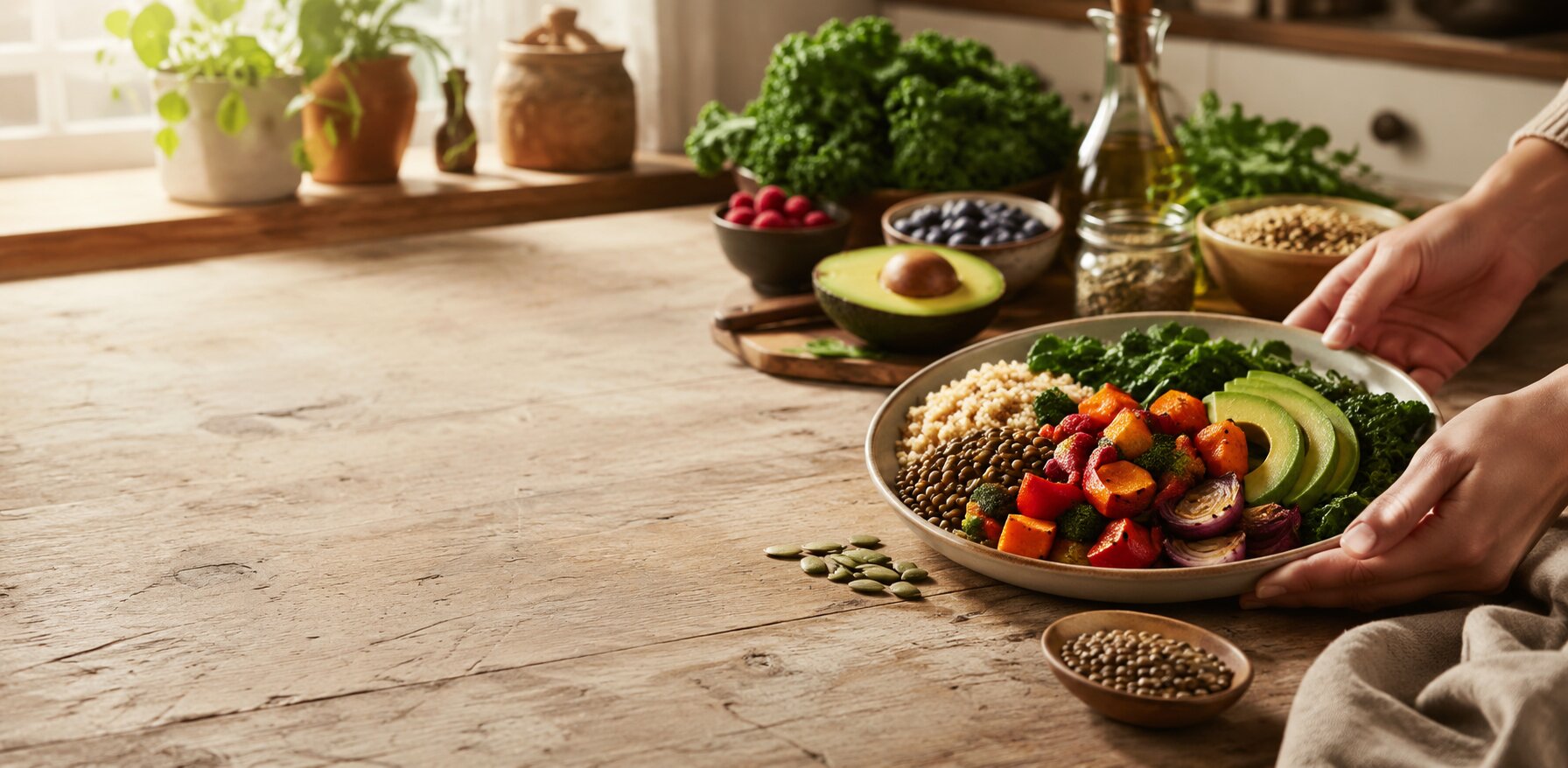
Whole plant foods are naturally low in calorie density. A large bowl of vegetables, legumes, and intact whole grains fills your stomach and activates stretch receptors that signal fullness to your brain. This is the satiety signal that works during the meal. Fiber helps you reach a stopping point before you've eaten too much.
Processed foods, on the other hand, don't work that way. They pack far more calories into a smaller volume because the fiber is gone. They're digested very quickly, and they don't take up as much space. By the time your stretch receptors say, "I'm full," it's way too late. You've eaten way more than you needed to.
Beans shift your hunger hormones, and the effect carries into the next day
Anne Nilsson and colleagues at Lund University ran a randomized crossover trial in which healthy adults ate either brown beans or white wheat bread as their evening meal. When they returned for a standardized breakfast the following morning, 11 to 14 hours later, the bean meal had raised PYY (a primary satiety hormone) by 51 percent and suppressed ghrelin (the hunger hormone) by 14 percent. Hunger sensations the next morning were 15 percent lower as well.
The mechanism is colonic fermentation. The fiber in beans feeds gut bacteria overnight. While you are sleeping, those bacteria produce short-chain fatty acids that raise your satiety hormones and lower your hunger hormones overnight. So, a bean dinner is not just a filling evening meal. It also helps regulate appetite the following morning.
This study, published in PLoS One in 2013, is worth noting. At our house, legumes are a part of almost every evening meal. And our morning meal is much lighter, like a fruit smoothie with flaxseed and fiber. This explains why this works so well.
Protein matters for satiety, and most plant-based eaters come up short
Now, this topic might be a bit touchy, but we do need to talk about protein a little. Getting adequate protein on a plant-based diet does require deliberate effort. Many people assume a small serving of legumes meets their protein requirements, but for many, it doesn't.
The research on satiety is consistent: adequate protein suppresses appetite between meals and preserves lean muscle during weight loss. On the Hallelujah Diet, low protein intake is a genuine gap for many people. If you are not eating legumes a couple of times a day, you are likely not hitting the levels that make weight management easier. Our Hallelujah Diet Essential Protein is a clean, plant-based protein powder that is a practical way to close that gap, whether in your morning smoothie or as a post-workout meal. It is not a workaround. It is part of eating well.
How to Put This Into Practice
The Hallelujah Diet is built around food quality, not calorie arithmetic. Vegetables, fruits, organic intact whole grains, legumes, and nuts and seeds in moderation. That structure produces the calorie density effect, the fiber and fermentation effect, and the hormonal regulation described above, without asking you to track a single number. You just follow the pattern.
Here are a few practical priorities worth emphasizing:
Make beans a daily habit, not an occasional one. The satiety effect is strong, and it carries forward into the next day. If you're not used to beans, your body will quickly adapt, and you won't have any problems digesting them. Don't worry about it. Long-term, it's a non-issue. If you do have issues initially, you can use a digestive enzyme supplement to aid digestion.
Prioritize protein at each meal. If legumes feel repetitive or you are not eating enough of them, Hallelujah Diet's Essential Protein closes the gap without compromising the diet's foundation.
Skip the processed plant foods. It is just as easy to overeat vegan chips, plant-based cookies, and processed meat alternatives as it is to overeat conventional processed food. The Hall NIH study did not distinguish between vegan and non-vegan processing. Ultra-processed is ultra-processed, regardless of the label. Stick to whole foods.
For a complete guide to structuring meals, understanding the mechanisms in more depth, and setting realistic weight loss timelines, read our full-length resource: How to Lose Weight on a Plant-Based Diet Without Counting Calories.
Hallelujah Diet Perspective
At Hallelujah Diet, we've seen many people lose excess body weight and maintain a normal body weight for many years without counting calories. They simply follow a plant-based, whole foods dietary pattern, and it works extremely well for them.
The fiber-rich foods satisfy them. Nutrient-dense foods nourish the body's cells, keeping them healthy. They have the energy they need to perform at their peak every day. They have the building blocks the body needs to repair daily wear and tear and maintain a high level of health.
When you couple a whole-foods, plant-based diet with healthy sleep patterns, effective stress management, daily physical activity, and intentional resistance training, you build a sustainable lifestyle that fuels your body and your life, so that you can accomplish the things that God has set before you.
You have time to invest in your family because you're not at the doctor's all the time. Your finances are not drained because of poor health. You can dream big. You have a sense of purpose and meaning that's not disrupted by your body getting in your way. And for that, we shout, “Hallelujah!”
Frequently Asked Questions
| Question | Answer |
| Do I need to count calories on a plant-based diet? | Most people do not. Clinical trials show significant weight loss from plant-based diets even without calorie restrictions, because high-fiber whole foods naturally regulate hunger and reduce intake without tracking. |
| What foods can I eat in large amounts without worrying about weight gain? | Non-starchy vegetables, leafy greens, legumes, and whole fruits are low in calorie density. You can eat substantial volumes of these foods and still remain in a natural calorie deficit. They also supply the fiber that drives your satiety hormones. |
| Does severe calorie restriction raise cortisol? |
Yes. Significant calorie restriction can elevate cortisol, the stress hormone, which promotes fat storage and muscle loss over time. Plant-based eating sidesteps this problem because it creates a natural calorie reduction through food quality rather than forced restriction. |
| Do I have to track anything at all? |
No, and that's the point. A Drexel University pilot study, specifically designed to test this question, found that most people struggle to maintain daily calorie tracking over the long term, while an unrestricted plant-based diet produced real weight loss without it. Some people still like checking in with an app, such as Cronometer, once a month as a gut check, rather than a daily habit. That's a personal preference, not a requirement. |
| Why do I feel hungrier than expected in the first couple of weeks? |
This is common early on, and it usually means you have not replaced enough volume yet, not that the approach has failed. Lean on calorie-sturdy whole foods like legumes, whole grains, avocados, and nuts and seeds. This will help you eat to genuine fullness, rather than undereating out of old calorie restriction habits. |
| Is this backed by actual research or just a trend? |
Beyond the 2017 trial above, a 2022 Physicians Committee pilot study and multiple randomized trials from Dr. Hana Kahleova's team have found similar ad libitum, no-calorie-limit results. |
References
- Hall KD, et al. Ultra-Processed Diets Cause Excess Calorie Intake and Weight Gain: An Inpatient Randomized Controlled Trial of Ad Libitum Food Intake. Cell Metabolism. 2019;30(1):67-77. https://doi.org/10.1016/j.cmet.2019.05.008
- Barnard ND, Levin SM, Yokoyama Y. A systematic review and meta-analysis of changes in body weight in clinical trials of vegetarian diets. Journal of the Academy of Nutrition and Dietetics. 2015;115(6):954-69. https://doi.org/10.1016/j.jand.2014.11.016
- Mutailipu K, et al. Plant-based caloric restriction diets versus conventional calorie-restricted diets for weight loss and metabolic health in obese adults: a 12-week randomized, open-label, non-inferiority trial. Frontiers in Nutrition. 2026;13:1805225. https://doi.org/10.3389/fnut.2026.1805225
- Turner-McGrievy GM, et al. Comparative effectiveness of plant-based diets for weight loss: a randomized controlled trial of five different diets. Nutrition. 2015;31(2):350-8. https://doi.org/10.1016/j.nut.2014.09.002
- Turner-McGrievy, G. M., Barnard, N. D., & Scialli, A. R. (2007). A two-year randomized weight loss trial comparing a vegan diet to a more moderate low-fat diet. Obesity (Silver Spring, Md.), 15(9), 2276–2281. https://doi.org/10.1038/oby.2007.270
-
Kahleova, H., Znayenko-Miller, T., Jayaraman, A., Motoa, G., Chiavaroli, L., Holubkov, R., & Barnard, N. D. (2025). Vegan diet, processed foods, and body weight: a secondary analysis of a randomized clinical trial. Nutrition & metabolism, 22(1), 21. https://doi.org/10.1186/s12986-025-00912-5
- Nilsson A, et al. Effects of a brown beans evening meal on metabolic risk markers and appetite regulating hormones at a subsequent standardized breakfast: a randomized cross-over study. PLoS One. 2013;8(4):e59985. https://doi.org/10.1371/journal.pone.0059985