


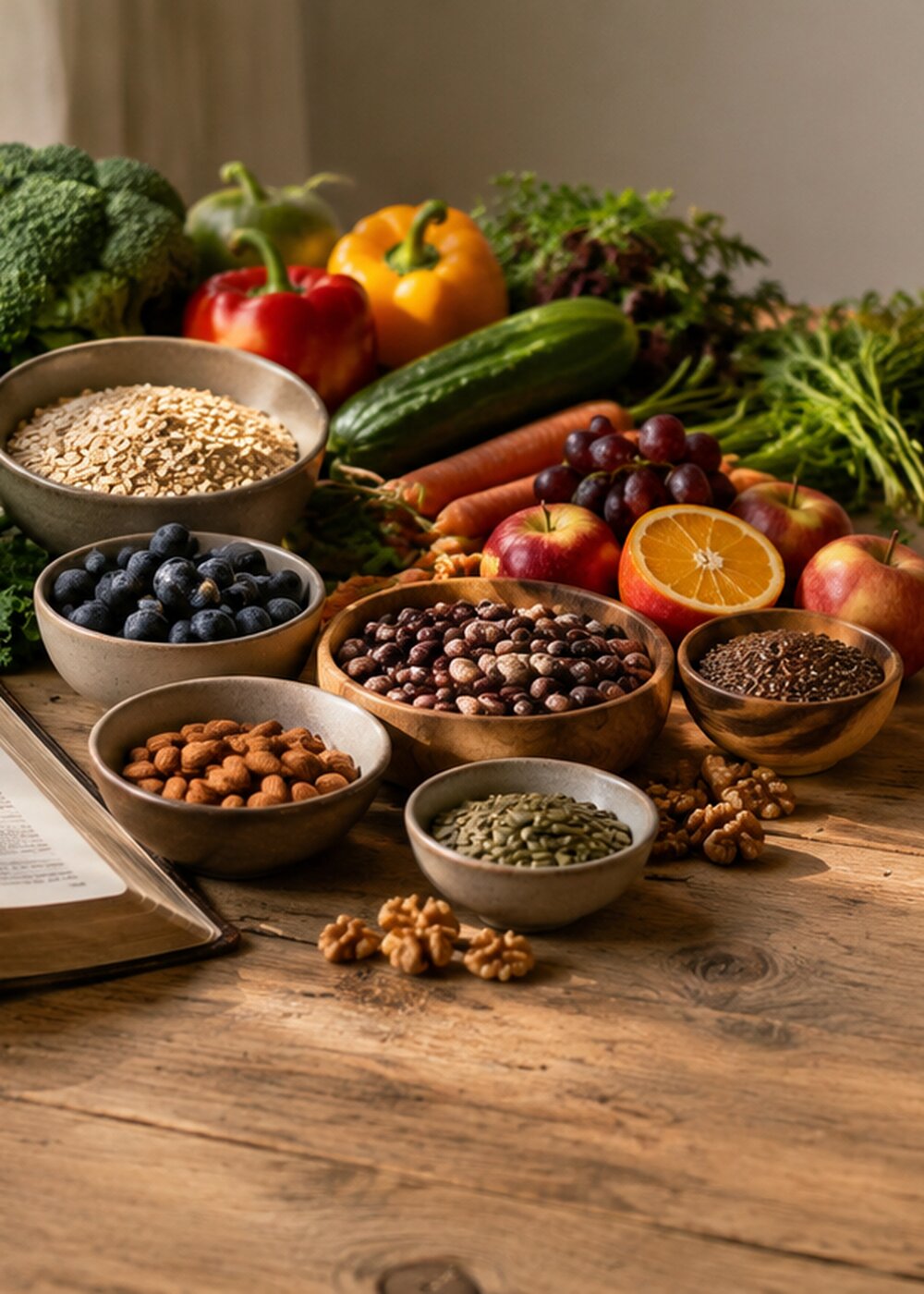
Food in Scripture
The passages, in order, with a short note on each
Download the printable version (PDF)Printable, and laid out to bring to a small group.
People ask us what the Bible says about food, and the honest answer is: more than most people expect, and less tidily than either side of the argument would like.
So rather than hand you our conclusions, here are the passages. Read them in order and the shape of it comes through on its own. That's better than being told.
Good for personal study. Also good for a small group — there's enough here for six evenings.
One · The garden
Genesis 1:29
“I have given you every herb bearing seed… and every tree, in which is the fruit of a tree yielding seed; to you it shall be for meat.”
The original provision, stated before anything went wrong. Plants bearing seed, fruit bearing seed. Worth noticing how specific it is.
Genesis 2:16–17
Freedom with a single boundary. The first thing asked of humanity concerned food.
Genesis 3:17–19
What changed. Notice that the curse touches the ground, and the work of getting food from it.
Two · After the flood
Genesis 9:1–4
Meat is permitted, with a restriction about blood. A different world from chapter one, and Scripture doesn't pretend otherwise.
Genesis 6:3
Set this beside the lifespans in chapter 5 and read them together. Draw your own conclusions; people have drawn several.
Three · The law
Leviticus 11
Clean and unclean animals, in detail.
Deuteronomy 14:3–21
The same ground covered again, with differences worth noticing.
Leviticus 3:17 · 7:23–27
Fat and blood, prohibited.
Daniel 1:8–16
Ten days, vegetables and water, and a comparison the text is happy to report. The origin of what people now call the Daniel Fast.
Numbers 11:4–6, 31–34
The complaint about manna, and what came of it. A hard passage about appetite.
Four · The prophets and the writings
Isaiah 55:1–2
“Why do you spend money for that which is not bread?”
About more than food, but not less than food.
Proverbs 23:1–3, 20–21
Restraint at the table, put plainly.
Ezekiel 4:9
The bread recipe. Grains and legumes together. Still made today.
Psalm 104:14–15
Provision described with obvious pleasure. Scripture is not suspicious of food.
Five · The Gospels
Matthew 6:25–33
Anxiety about food, addressed directly.
Mark 7:14–23
What defiles a person. One of the most argued-over passages here, and worth reading slowly with the context.
Luke 24:41–43 · John 21:9–13
The risen Christ eats fish. Whatever conclusions you reach elsewhere have to sit alongside this.
Matthew 15:32–39
Feeding a crowd. Bread and fish, given thanks for, multiplied.
Six · The letters
Acts 10:9–16
Peter's vision. Read on to verses 28 and 34 for what Peter says it meant.
Romans 14:1–23
Food, conscience, and refusing to despise a brother who eats differently. If you read only one passage in this guide, we'd choose this one.
1 Corinthians 8 · 10:23–33
Freedom, limited voluntarily for someone else's sake.
1 Corinthians 6:19–20
The body as a temple. Often quoted about food; read the context and see what it's actually addressing.
1 Timothy 4:1–5
A warning against forbidding foods. Worth sitting with, particularly for anyone drawn to strictness.
Colossians 2:16–23
Don't let anyone judge you regarding food. Then a caution about harsh treatment of the body.
How we'd read it
Six evenings, one section each. Read the passage, then ask two questions:
Not what you've heard about it. Read the verses around it.
Provision, boundary, health, worship, freedom, love of neighbor — food is doing different work in different places.
One caution, offered gently
It's possible to read this collection and come away with a new set of rules, and Romans 14 and 1 Timothy 4 are both there to keep that from happening. Scripture is remarkably relaxed about what a brother eats, and remarkably serious about whether we despise him for it.
We think Genesis 1:29 describes where nourishment was put. That's a conviction we hold and have built a life around. It isn't a test of anyone's faith, and we'd rather you arrive at your own reading than borrow ours.
“Why do you spend money for that which is not bread? and your labour for that which satisfieth not?”
Isaiah 55:2
Read them in order and the shape comes through on its own. We'd rather that than hand you ours.
Blessings,
Paul & Ann
Read next
What the Bible Actually Says About Food
Our reading of the whole arc — the garden, the flood, the law, the table, and the letters that argued about all of it.
Read the articleFor the practical side
The Yes List — 25 foods worth adding
What this actually looks like on a plate, without a single thing you have to give up. One page, free.
Already on our list? You can ignore this — it won’t show once we know you.