


She’s doing everything “right.” Eating her vegetables. Taking her supplements. Drinking the water. And yet the scale hasn’t moved in months, she wakes up puffy every morning, and there’s this low-grade exhaustion that no amount of sleep seems to fix.
If that sounds familiar — or if you’ve heard a version of it from someone you love — we want to share something that most practitioners miss entirely. Something that sits quietly at the intersection of thyroid health, hormones, and the foods we eat. Something called histamine.
Not histamine the allergy molecule. Not the antihistamine you take when your nose runs in April. We’re talking about histamine as a whole-body signaling system — one that, when it gets overloaded, can look an awful lot like hypothyroidism. Or depression. Or just being tired all the time for no good reason.
We’ve spent decades learning how the body works when it’s given what God designed it to have — and how it struggles when it’s not. This is one of those conversations we wish someone had started much sooner.
Key Takeaways:
- Histamine does far more than trigger allergies.
- Histamine may influence energy, sleep, digestion, and hormone balance.
- Histamine and thyroid function can affect one another through multiple pathways.
- Hormonal fluctuations may amplify histamine-related symptoms.
- Supporting gut health and the body's natural clearing systems may help reduce overall burden.
What Histamine Actually Does in Your Body

Most people only think about histamine during allergy season. But histamine is active in your body every single day. It regulates how awake you feel. It helps your stomach make acid for digestion. It signals your immune system. It even plays a role in your heartbeat and how your blood vessels relax or tighten.
God designed histamine as a helpful messenger. The problem comes when there’s too much of it, and your body can’t break it down fast enough.
The primary enzyme that clears dietary histamine from your gut is called Diamine Oxidase — DAO for short. Think of it like a cleanup crew stationed in your small intestine. When DAO is doing its job, histamine from your food gets degraded right at the gut wall before it ever reaches your bloodstream. You never feel a thing.
But when DAO is depleted — by gut inflammation, certain medications, nutritional deficiencies, or genetic factors — histamine slips through. It circulates. It accumulates. And then your body starts sending signals that can be genuinely confusing to sort out.
Bloating. Headaches. Flushing. Anxiety. Brain fog. Trouble sleeping. Water retention. A racing heart after meals. Sound like a lot of other things? It should. Histamine intolerance is one of the most frequently missed pieces of the puzzle in women’s health.
The Thyroid Connection Most Doctors Don’t See

Here’s where it gets particularly relevant for women navigating Hashimoto’s thyroiditis — or any kind of thyroid challenge.
The relationship between histamine and thyroid function runs in both directions. Low thyroid hormone levels increase the density and reactivity of mast cells — the immune cells that store and release histamine. More mast cells means more histamine. More histamine means more inflammation in thyroid tissue, which in turn impairs the body’s ability to convert the storage form of thyroid hormone (T4) into the active, usable form (T3).
Less T3 means slower metabolism. More fatigue. More weight-loss resistance. And a continued cycle that feeds itself.
There’s also the gut piece. Hypothyroidism slows down digestion, which creates the conditions for bacterial overgrowth in the small intestine — and many of those bacteria produce histamine directly. So sluggish thyroid function doesn’t just make you feel slow. It can actually deepen a histamine problem that then makes the thyroid situation harder to resolve.
We want to name this clearly: many symptoms that get attributed to “just hypothyroidism” may be significantly driven by histamine overload. The fatigue, the brain fog, the puffiness, the stubborn weight — these are not all thyroid. And addressing only the thyroid while ignoring the histamine piece leaves a big part of the picture unaddressed.
The Estrogen Loop: Why This Affects Women So Specifically

If you’re a woman in your 40s, 50s, or older and things feel suddenly, unexplainably worse — new intolerances, worse allergies, waking at 3 AM, gaining weight without changing anything — here’s something important to know.
Estrogen and histamine drive each other. Estrogen stimulates mast cells to release histamine. Histamine signals the ovaries to make more estrogen. As progesterone declines in the years approaching menopause, that natural counterbalance disappears — because progesterone is what stabilizes mast cells and supports DAO production. Without it, the cycle accelerates.
This is why histamine intolerance is disproportionately common in women, and why it so often surfaces or worsens during perimenopause. It’s not random. It’s not imagined. It’s the biology of an imbalance that nobody thought to connect because the dots are spread across immunology, endocrinology, and gastroenterology — three specialties that rarely sit in the same room together.
The good news is that the body’s design is not broken. It’s responding to an overload. And when you reduce that overload, you give it room to find its way back.
What God’s Original Design Points Us Toward
Genesis 1:29 gave us “every plant yielding seed” and “every tree with seed in its fruit” as our foundational nourishment. Living, enzyme-rich, whole foods are what this body was made to receive.
But for someone navigating histamine overload — especially in combination with Hashimoto’s — some of the foods we associate with health and healing are actually adding to the burden. Not because they’re bad foods. But because fermentation, aging, and certain food compounds interact with an already-overloaded histamine system in ways that are worth understanding.
Some of the most common histamine triggers in a whole-food, plant-based kitchen include:
- Fermented foods — sauerkraut, kimchi, kombucha, tempeh, miso, soy sauce, apple cider vinegar, coconut liquid aminos, nutritional yeast
- High-histamine vegetables — ripe tomatoes, eggplant, spinach, and ripe avocado
- Histamine-releasing fruits — citrus, strawberries, kiwi, pineapple, dried fruit
- Problematic nuts — walnuts, cashews, peanuts
- Alcohol of any kind, and black or green tea
None of this means these foods are permanently off the table. It means that during a period of overload — when the bucket is already full — they keep it from clearing. A four-to-six week elimination gives the system a chance to rest, the gut lining a chance to recover, and the DAO enzyme a chance to rebuild.
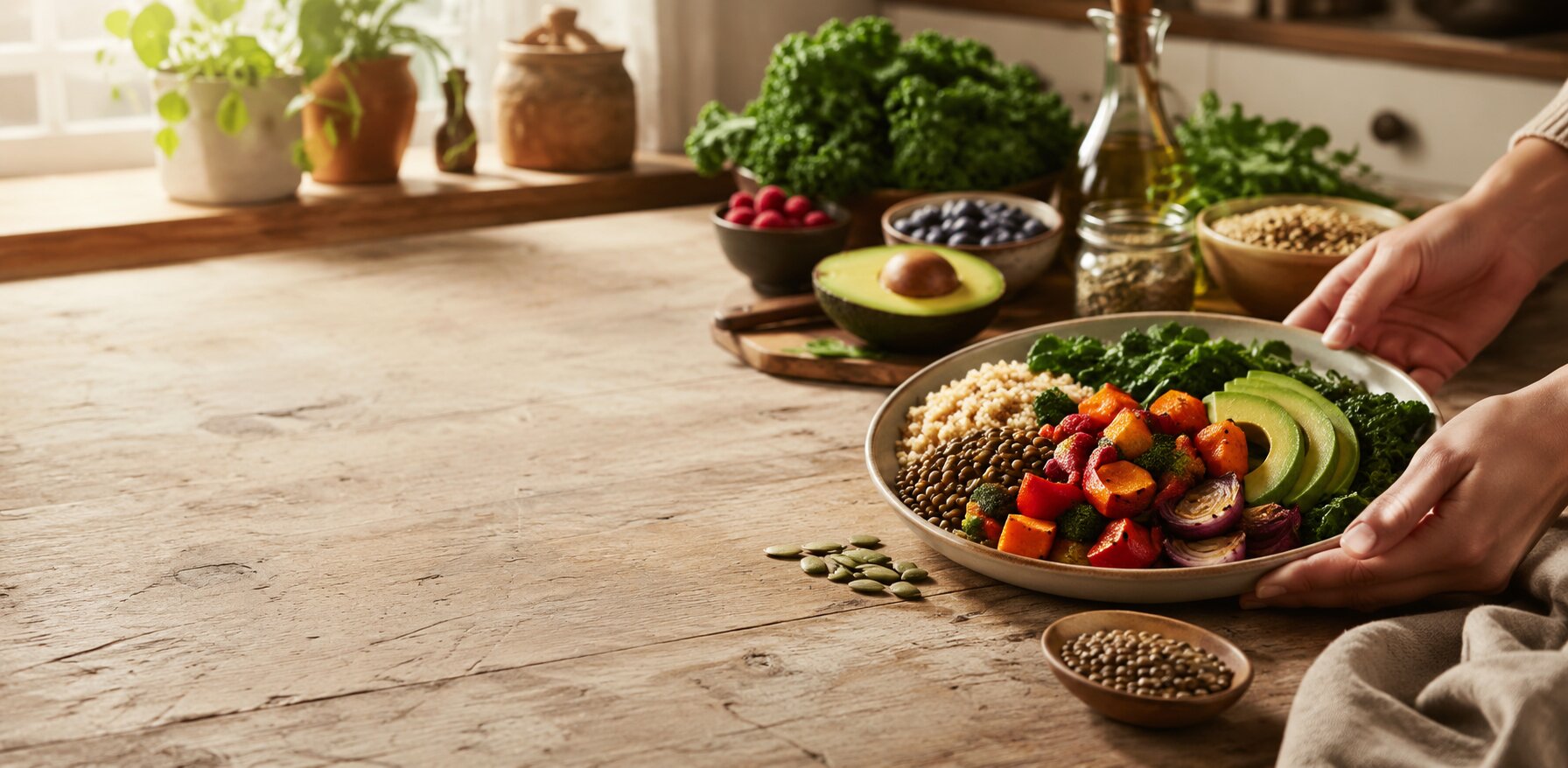
Some of the best-tolerated foods during this season: broccoli, cauliflower, cabbage, carrots, zucchini, cucumber, fresh herbs, collards, Swiss chard, dandelion greens, arugula, asparagus, romaine, rice, millet, oats, quinoa, apple, pear, mango, blueberries, macadamia nuts, hemp seeds, and plenty of olive oil. God gave us an abundant table even within the limits of a healing season.
Supporting Your Body’s Natural Clearing Capacity

The DAO enzyme — your gut’s primary histamine clearance system — requires specific nutrients to function well. These aren’t obscure supplements. They’re nutrients that support hundreds of processes in the body, and in a modern diet with gut challenges layered on top, deficiency is genuinely common.
Vitamin C works directly with DAO and has an inverse relationship with blood histamine levels — as C goes up, histamine tends to come down. Vitamin B6 (in its active P5P form) activates the enzyme itself. Research has shown that without adequate B6, DAO supplements provide little to no benefit. Magnesium activates DAO function at the cellular level. Zinc stabilizes the enzyme. Copper binds directly to DAO’s active site and enables it to do its work.
Quercetin — found naturally in capers, red onions, apples, and broccoli — is one of the most studied natural mast cell stabilizers we have. It helps quiet the immune cells that release histamine before they fire, rather than just mopping up the histamine afterward.
Supplements are tools, not foundations. The real foundation is gut health — addressing bacterial overgrowth, healing the intestinal lining, restoring a microbiome that degrades histamine rather than producing it. That’s longer work. But it’s the work that creates lasting change.
Simple Steps to Begin
If you’re wondering whether histamine might be a piece of your picture, here’s a gentle way to start exploring:
- For one week, keep a simple journal: what you ate, how you felt an hour later, and how you slept. Patterns often emerge quickly.
- Pay attention to what’s fermented in your daily routine — kombucha, vinegar dressings, soy sauce, nutritional yeast. These are quiet contributors that rarely get named.
- Fresh food is lower in histamine than leftover food. Histamine accumulates in food as it sits, even refrigerated. Cooking fresh and eating promptly matters more than most people realize.
- If you’re taking a probiotic, check the strain list. Lactobacillus casei and L. bulgaricus produce histamine; L. plantarum and Bifidobacterium strains help degrade it. The label matters.
- Stress is not separate from this. Emotional stress triggers mast cell degranulation directly — the same cells that release histamine. A nervous system that never fully rests is a histamine system that never fully calms.
This isn’t about fear or restriction. It’s about paying attention to what the body is telling us, and giving it the conditions it was designed to thrive in.
Author's Note
This article is based on current research, clinical observations, and years of experience working with individuals seeking nutritional and lifestyle approaches to wellness. While every person's situation is unique, understanding how histamine, thyroid function, hormones, and overall health interact can provide valuable insight into symptoms that are often overlooked.
The goal is not to diagnose or treat disease, but to provide educational information that helps you make more informed health decisions.
A Note of Encouragement
We’ve walked alongside thousands of people over the decades, and one of the most common things we hear is: “I’ve tried everything.” What we’ve seen, again and again, is that the missing piece is usually something simple — something the body has been asking for all along, just in a language nobody taught us to understand.
If you’re carrying unexplained symptoms that no one has been able to explain, we hope this is one of those moments where something clicks. Not because we have all the answers, but because God designed a remarkably self-healing body, and sometimes what it needs most is for us to stop adding burden and start creating space.
That’s what we’re here to help you do.
The complete guide — Histamine, Hashimoto’s & Hormones: The Missing Connection Behind Your Symptoms and How Food Can Change Everything — is available at AMPMforHealth.com.
Begin with the free guide at MyHDiet.com, or visit AMPMforHealth.com for the complete book and the full scope of our work.
We offer these teachings freely to support clarity, stewardship, and responsible care. If this article was helpful, you may explore additional resources here:
- AMPMforHealth.com — the complete book and primary author platform
- MyHDiet.com — plant-based nutrition, enzymes, detox foundations
- WipeOutToxins.com — toxin-free living and prevention
- CleanseYourBlood.com — circulation and blood-flow support
- HealthRetreat.com — immersive wellness retreats
Thank you for being part of a community committed to thoughtful, responsible healing.


1 comment
Colleen Joy
Thank you
Thank you