




The food industry is obsessed with counting calories. Every food package must display the calories in bold at the top. Tracking apps abound. MyFitnessPal is worth hundreds of millions of dollars. The diet tracking industry is worth billions of dollars.
The message has been pounded into our heads that we have to count calories to lose weight.
What if they're all wrong? Could it be that you don't need to count calories to lose weight and to live healthily?
In this article, I'm going to explore this question and show you why you can quit counting calories. You just need to eat the right foods. So let's dig in.
|
Quick Answer Yes, you can lose real weight on a plant-based diet without counting a single calorie. Neal Barnard and colleagues at the Physicians Committee for Responsible Medicine put this to the test directly: in a 14-week randomized trial, women eating a low-fat vegan diet with no calorie limit lost more weight than a calorie-conscious control group, 5.8 kilograms versus 3.8. The food does the counting for you, because whole plant foods fill you up long before you've eaten too much. |
Why You Don't Have to Count Anything
Here's the thing about calorie counting: it treats every calorie the same, whether it comes from broccoli or a candy bar. Your body doesn't work that way, and neither does hunger.
A 2017 community trial out of New Zealand, the BROAD study, published in Nutrition and Diabetes, put this to a real-world test. Sixty-five adults with obesity were told to eat a whole-food plant-based diet ad libitum, meaning as much as they wanted, whenever they wanted. No portions. No tracking. At six months, they'd lost an average of 12.1 kilograms. At twelve months, they'd kept off 11.5 of it. Nobody in that study opened a calorie app.
Closer to home, and closer in timeframe, Erin Campbell and her team at the University of Rochester ran an eight-week version of this same approach in a real primary care clinic, published in the journal Nutrients in 2019. Seventy-nine adults, many of them already dealing with diabetes, high blood pressure, or heart disease, ate the same way: whole plant foods, no calorie counting, no portion control. In eight weeks, they lost an average of 5.5 kilograms. Blood pressure came down. Cholesterol came down. And over a quarter of them were able to reduce or stop a chronic medication entirely, under their doctor's supervision, because their numbers had genuinely improved. Eight weeks. No counting. That's how fast this can move once the food changes.
Why does that happen? Whole plant foods like vegetables, legumes, fruit, and intact whole grains are heavy with fiber and water and light on calories. A pound of lentils runs about 500 calories. A pound of cheese runs about 1,800. Eat until you're full on the first one and you land in a deficit without trying. Eat until you're full on the second and you've blown past what you meant to eat before you even notice.
That’s it. That's the basic mechanism you need to understand. Fiber slows digestion and triggers the hormones that tell your brain you've had enough. Fat and refined carbs don't send that signal nearly as fast, so it's easy to eat past full before your body catches up.
What to Eat This Week
Forget the twelve-week meal plan for a second. Here's what actually needs to be on your plate, starting with your next meal.
-
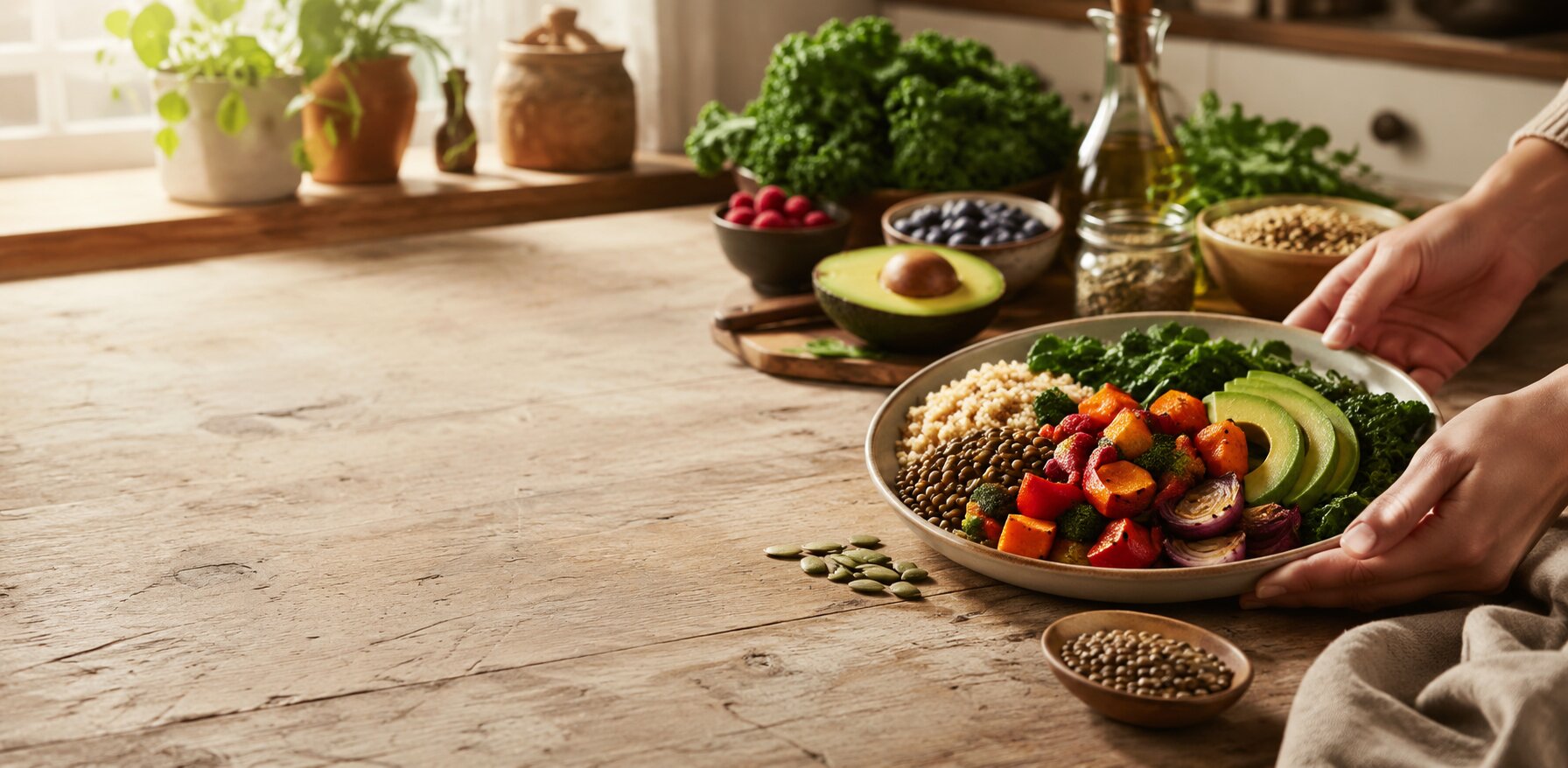
Vegetables, as much as you want. Leafy greens, broccoli, peppers, cucumbers. There's essentially no upper limit here. Vegetable juice counts too.
-
A cup of legumes a day. Lentils, chickpeas, black beans. This is the single most important habit on this list. They're filling, they're high in protein and fiber, and they stabilize your blood sugar for hours.
-
Intact whole grains over milled ones. Brown rice, steel-cut oats, quinoa, barley. Skip the flour products when you can.
-
Fruit, freely. The sugar in whole fruit comes packaged with fiber and water, so it behaves completely differently in your body than the sugar in juice or a candy bar. If you're nervous about it, lean toward berries.
-
A small handful of nuts or seeds, not a bag of them. Ground flaxseed in your oatmeal, tahini in your hummus, a scoop of walnuts. These are calorie-dense, so a little goes a long way.
And here's what to leave off the plate most of the time: refined oil (120 calories per tablespoon, all fat, no fiber), processed vegan substitutes that trade real food for a longer ingredient list, and added sugar. None of that is about willpower. It's just that these foods don't fill you up the way whole plant foods do, so you end up eating more of them to feel satisfied.
A Realistic Timeline
Don't worry about a number on a schedule. How fast you lose weight depends on where you're starting, how consistently you're eating this way, and things that have nothing to do with food: sleep, stress, activity level.
What the research is consistent about is the shape of it, not the speed. Weight comes off steadily over the first several months, and unlike a lot of restrictive diets, it tends to stay off, because you're not white-knuckling a deficit. You're just eating differently. The BROAD study's participants kept nearly all their loss a full year out. That's the real win here: not the fastest path, the one you can actually stay on.
What the research is consistent about is the shape of it, not the speed. A 2019 systematic review by Evelyn Medawar and colleagues, published in Translational Psychiatry, looked across the literature on this and found the same pattern holding up study after study: plant-based eating produces weight loss without calorie restriction, not as a one-off result in a single trial, but as a consistent finding across the research. Weight comes off steadily over the first several months, and unlike a lot of restrictive diets, it tends to stay off, because you're not white-knuckling a deficit. You're just eating differently. The BROAD study's participants kept nearly all their loss a full year out. That's the real win here: not the fastest path, the one you can actually stay on.
Getting Started Without Overhauling Your Whole Kitchen
You don't have to do this all at once. Start with two or three plant-based meals a week and build from there.
-
Cook a big pot of lentils or beans once. Use them in three different meals.
-
Keep it to five or six meals you can make without thinking: a big salad with beans, lentil soup, a stir-fry over brown rice, rice and beans with avocado.
-
Batch-cook your grains and wash your vegetables ahead of time. Food that's ready to eat gets eaten.
A concentrated green like BarleyMax can help fill in the gaps on a busy week, a scoop gives you something close to a serving of raw vegetables in about ten seconds, but it's a complement to the vegetables on your plate, not a substitute for them.
Frequently Asked Questions
Do I need to weigh or measure my food at all? No. That's the point of eating this way. Focus on filling your plate with whole plant foods and eating until you're comfortably full, not stuffed. The volume and fiber do the regulating for you.
What if I'm still hungry between meals? Reach for more of the same foods, not less. A bigger bowl of lentil soup or an extra piece of fruit is very different from reaching for a processed snack. On this way of eating, hunger between meals almost always means you haven't eaten enough volume, not that you need to hold out.
Is this actually different from just eating less meat? Yes. The research above compared whole-food plant-based eating specifically, not a vague reduction in animal products, to calorie-restricted or conventional diets. The quality of what replaces the animal products matters. A vegan diet built on white bread and vegan junk food won't produce these results. A vegan diet built on vegetables, legumes, and intact whole grains will.
Will I lose muscle along with fat? Not much, if you're eating enough legumes. The research above focuses on body weight loss in general, and legumes provide enough protein to support muscle during that process. Resistance exercise is key to maintaining lean body mass while losing weight.
Hallelujah Diet Perspective
God gave us our original diet in Genesis 1:29. He didn't tell us to count calories. He just gave us the kinds of foods that would both satisfy us and nourish us. It was plants. It was fruits and vegetables, nuts, seeds, whole grains, and legumes. Let this be your guide, and focus on eating these foods. And don’t sweat imperfection. You don’t have to be perfect to get great results.
You can find freedom from counting calories. Just one more reason to shout, “Hallelujah!”
References
1. Barnard ND, Scialli AR, Turner-McGrievy G, Lanou AJ, Glass J. The effects of a low-fat, plant-based dietary intervention on body weight, metabolism, and insulin sensitivity. American Journal of Medicine. 2005;118(9):991–997. https://doi.org/10.1016/j.amjmed.2005.03.039
2. Wright N, Wilson L, Smith M, Duncan B, McHugh P. The BROAD study: A randomised controlled trial using a whole food plant-based diet in the community for obesity, ischaemic heart disease or diabetes. Nutrition and Diabetes. 2017;7(3):e256. https://doi.org/10.1038/nutd.2017.3
3. Campbell EK, Fidahusain M, Campbell TM II. Evaluation of an eight-week whole-food plant-based lifestyle modification program. Nutrients. 2019;11(9):2068. https://doi.org/10.3390/nu11092068
4. Medawar E, Huhn S, Villringer A, Veronica Witte A. The effects of plant-based diets on the body and the brain: a systematic review. Translational Psychiatry. 2019;9(1):226. https://doi.org/10.1038/s41398-019-0552-0


1 comment
Barb Wohlbrandt
My favorite foods are green smoothies, blended salads, leafy green salads, and fresh fruit like bananas, berries, and apples. Most of these foods I buy organic.
My favorite foods are green smoothies, blended salads, leafy green salads, and fresh fruit like bananas, berries, and apples. Most of these foods I buy organic.