





Nitric oxide (NO) is a powerful molecule in your body that helps your blood vessels relax, improving blood flow and heart health. The best part? You can boost your nitric oxide levels just by eating the right veggies! Some vegetables are packed with nitrates, which your body turns into nitric oxide, giving you benefits like lower blood pressure and even better exercise performance. You need about 300 mg of nitrates a day to get the full benefits seen in research studies. In this article, we’ll look at the top 10 best vegetables that naturally increase nitric oxide, and show you how to add them to your diet for the best results!
Arugula (Rocket Lettuce)

Arugula: The Highest Nitrate Vegetable You're Probably Not Eating Enough Of
Arugula is the unsung hero of the nitric oxide world. Most people think of beets first, but arugula actually blows beets out of the water in terms of nitrate concentration. The European Food Safety Authority has reported nitrate levels in arugula as high as 7,000 mg per kilogram, with typical fresh samples coming in around 4,500 mg/kg. Compare that to beets at roughly 1,500 to 2,500 mg/kg, and you see why arugula deserves top billing.
Here's what makes the comparison between beets and leafy greens especially interesting. Van der Avoort and colleagues conducted a randomized crossover trial, published in the Journal of the Academy of Nutrition and Dietetics in 2020, that directly compared beetroot juice against a nitrate-rich vegetable diet in 30 healthy young adults. Beetroot juice produced higher plasma nitrate and nitrite levels. But here's the key finding: both groups reduced systolic and diastolic blood pressure to the same extent. The vegetables got you there just as well, even if the blood nitrate numbers looked a little different.
A small handful, about 50 grams, of fresh arugula can give you 200 mg or more of dietary nitrates. That's a significant contribution toward the 300 mg daily target that researchers associate with cardiovascular benefits.
Arugula has a bold, peppery flavor that works especially well in salads, on flatbreads, or blended into a green juice alongside beets and celery. It loses some of its punch when cooked, so raw is best.
How to Use: Add it to salads, sandwiches, or blend it into green smoothies.
Spinach

Why It’s Great: Spinach is packed with nitrates and provides a substantial boost to NO levels. 100g (3.5 ounces) of raw spinach has around 70-200 mg of nitrates. Exact amounts depend on growing conditions and seasonal variations.
How to Use: Eat it raw in salads, blend into smoothies, add it to your fresh vegetable juice or lightly steam it.
Beets (Beetroot)

Why It’s Great: Beets are famous for their high nitrate levels and are often used to boost exercise performance and lower blood pressure. One cup of raw beets contains as much as 400-500 mg of nitrates. A cup of beet root juice has about 200 mg of nitrates.
Beetroot and Nitric Oxide: What the Clinical Research Shows
Beets deserve their own moment in the spotlight. Of all the vegetables on this list, beets have the most clinical research behind them for both blood pressure and athletic performance.
A well-known study by Kapil and colleagues, published in Hypertension in 2015, enrolled 68 hypertensive patients in a double-blind, placebo-controlled trial. Participants drank 250 ml of beetroot juice daily for four weeks. Systolic blood pressure dropped by about 8 mmHg and diastolic by about 4 mmHg. Just one cup of beetroot juice a day made a clinically meaningful difference, without medication. That is remarkable.
How does it work? Beet juice is one of the richest dietary sources of inorganic nitrate. When you drink it, bacteria on your tongue convert that nitrate to nitrite. Then your body converts the nitrite to nitric oxide. The nitric oxide signals your blood vessel walls to relax, widening the vessels, improving blood flow, and lowering blood pressure.
Some of the nitrate is converted to nitrite right on your tongue. It's a good idea to sip your beet juice, swish it around your mouth, and consume it slowly for the best results.
If you want a convenient, concentrated option, our BeetMax powder delivers the nitrate punch of whole beets in a simple daily scoop.
How to Use: Enjoy raw, roasted, juiced, or blended into smoothies.
Swiss Chard

Why It’s Great: Swiss chard is closely related to beets and is similarly high in nitrates, making it an excellent choice for supporting NO production.
How to Use: Use in salads, sautéed dishes, or green juices.
Celery

Why It’s Great: Celery, especially the stalks and leaves, is a rich source of dietary nitrates. It’s also hydrating and low in calories, making it a great addition to juices and smoothies.
How to Use: Add to salads, soups, or fresh-pressed juices.
Lettuce (Romaine, Butterhead)

Why It’s Great: All of the lettuce species are high in nitrates. Even iceberg lettuce has a decent level of nitrates. A spring mix is a great option for salads. Typical nitrate levels for lettuce are around 150-200 mg for 3.5 oz (100 g) serving.
How to Use: Use as a salad base or in wraps and sandwiches.
Bok Choy (Chinese Cabbage)

Why It’s Great: Bok choy contains moderate levels of nitrates and is also rich in vitamin C, which can help stabilize and preserve nitric oxide.
How to Use: Use in stir-fries, soups, or raw in salads.
Radishes

Why It’s Great: Radishes are a great source of nitrates and also provide a peppery flavor to dishes, making them ideal in salads or as a garnish.
How to Use: Slice raw into salads or add to sandwiches.
Kale

Why It’s Great: While not as nitrate-rich as spinach or arugula, kale still contains good amounts of nitrates and is packed with other health benefits like antioxidants.
How to Use: Use raw in salads, steamed, or blended into smoothies.
Cilantro

Why It’s Great: Cilantro (or coriander leaves) is another very high-nitrate leafy green that can enhance NO levels and add flavor to dishes. Cilantro is also great for detoxifying heavy metals, so it is a win-win for you.
How to Use: Sprinkle fresh cilantro on salads, salsas, or add to juices.
Frequently Asked Questions About Vegetables and Nitric Oxide
Does cooking beets destroy nitric oxide?
This is a common and important question. The short answer is: cooking does reduce the nitrate content of beets somewhat, but not enough to make them useless.
Here is the distinction that matters. Raw beets contain nitrates, not nitric oxide itself. The conversion from nitrate to nitric oxide happens in your body, with help from bacteria on your tongue and in your gut. Boiling beets causes some nitrate to leach into the cooking water, with estimated losses of around 20 to 50% depending on cooking time and temperature. Roasting causes less loss than boiling. Steaming is somewhere in between.
So yes, cooking beets does reduce their nitrate content. But a cooked beet still contains a meaningful amount of nitrate, and it's far better than not eating beets at all. If you want to maximize nitrate delivery, raw beets or cold-pressed beet juice are your best options. Beet powder, which is made from dehydrated beets without high-heat processing, retains nitrates well and is a practical daily option.
Does stomach acid destroy nitric oxide from vegetables?
No. Dietary nitrate from vegetables survives stomach acid just fine. The conversion process actually works better in an acidic environment. In fact, the acid in your stomach helps convert nitrite to nitric oxide directly. This is why mouthwash is something researchers flag as a potential problem: when you use antibacterial mouthwash, you kill the bacteria on your tongue that do the first step of nitrate-to-nitrite conversion, and you can blunt the blood pressure benefits of a nitrate-rich meal.
Will using mouthwash cancel out the benefits?
Possibly, depending on timing. The nitrate-to-nitric oxide conversion is a two-step process. First, bacteria on your tongue convert dietary nitrate to nitrite. Then your body converts nitrite to nitric oxide. Antibacterial mouthwash kills the oral bacteria that perform that first step.
Govoni and colleagues at the Karolinska Institutet tested this directly in a crossover study and found that a chlorhexidine-containing antibacterial mouthwash markedly attenuated the rise in plasma nitrite that normally follows a dietary nitrate load. In other words, the mouthwash interrupted the conversion process before it could get started.
You don't have to give up mouthwash entirely, but using it right before or after eating nitrate-rich vegetables is likely working against you. If cardiovascular health is a priority, it's worth considering the timing or choosing a non-antibacterial rinse when you can.
Can I get enough nitric oxide from food alone?
Yes, absolutely. A daily salad with arugula, spinach, and some raw beets, combined with other vegetables from this list, can comfortably reach or exceed the 300 mg nitrate threshold associated with meaningful cardiovascular benefits in the research literature. You don't need supplements to hit that target. That said, for people managing blood pressure, incorporating whole beet powder or beet juice into your daily routine is an easy way to ensure you're consistently getting a therapeutic dose.
Bonus Tip:
To maximize nitric oxide production, try combining several of these vegetables in one meal, such as a salad or a green juice, to create a synergistic effect. Consuming them raw or minimally cooked is ideal, as high heat can reduce nitrate levels.
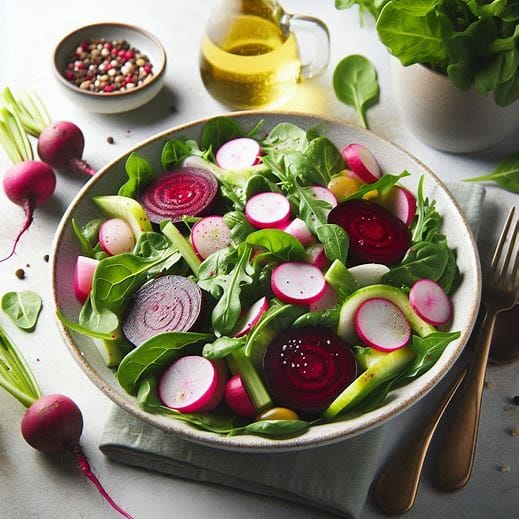
If you’re aiming for the highest NO boost, a salad with arugula, spinach, and beets, topped with some radish and celery, will deliver a potent dose of dietary nitrates!



2 comments
Elizabeth Halvorsen
Great insight in helpful blood pressure and cardiac support. Thank you!
Great insight in helpful blood pressure and cardiac support. Thank you!
Beverly Benner
I appreciate your helpfulness and thoroughness in supplying factual information.
I appreciate your helpfulness and thoroughness in supplying factual information.